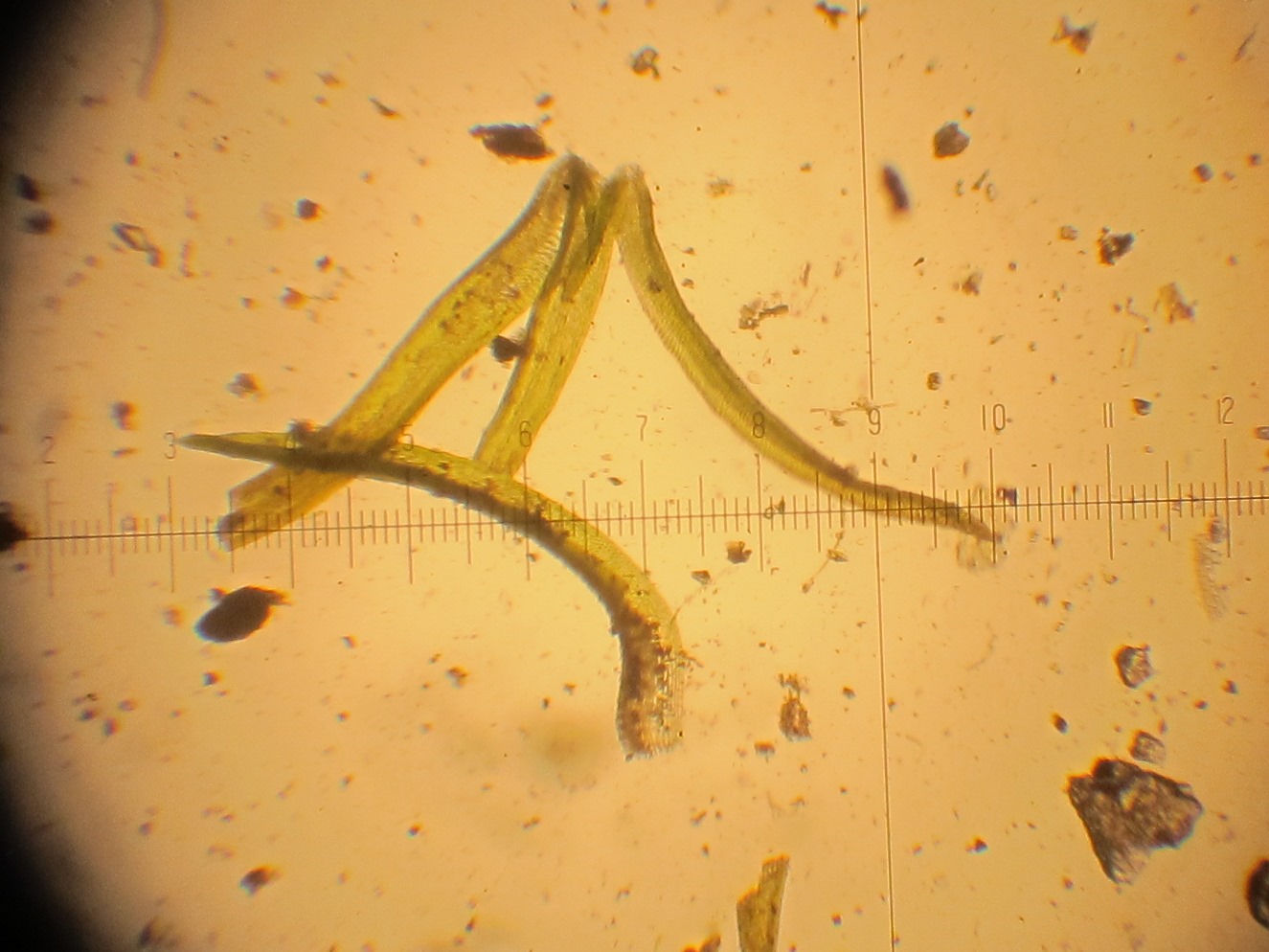
A 30-40 minute stop to check out a patch of 'wasteground' by D'Arcy Business Centre yesterday revealed a rich diversity of Didymodon spp., those recorded being fallax, ferrugineus, luridus, tophaceus, umbrosus (below, photos 1 & 2) plus what might be icmadophilus, which will be the first time I've seen it away from the Gorseinon area if confirmed. There was also some Pellia endiviifolia which was fruiting in patches denser than I recall seeing before (photo 3) and a little Bryoerythrophyllum ferruginescens. No Funaria was seen! Vascular plant interest was provided by a strong colony of 300+ seedlings of what could be Filago vulgaris (photos 5 & 6), though needs checking in Poland and/or by growing on my specimen - unless anyone knows this species at this age?
Showing posts with label umbrosus. Show all posts
Thursday, 12 April 2018
Wednesday, 30 August 2017
Caldey Island
During our bank holiday visit to the island, casual recording produced a little Didymodon umbrosus on the north-facing wall that houses dovecote adjacent to the Old Priory (approx. location shown), which appears to be new for Pembs. We never ventured onto the coastal parts of the island, so the only other casual observations were of fairly routine fare.
Back in Tenby a rust on a well-established colony of Malva pseudolavateraall up the esplanade zig-zag may be of interest (I'll email Mr Stringer to check the id, but I'm suspecting Puccinia malvacearum). Plenty other good vascular plants there too including Clinopodium ascendens, Salvia verbenaca and Verbascum nigrum. Unfortunately Carpobrotus edulis was among the non-natives thriving there!
Sunday, 19 March 2017
Barry in Barry
Note patent leaves bent out from hyaline sheaths with very narrow marginal cells. Also bistratose mid-leaf margins extending to a blunt, flat leaf tip
Adjacent to the breakwater, the tufa cliffs in Jackson Bay ST120666, which extend almost all the way along the east cliff of Nell's Point, held abundant Adiantum capillus-veneris and Eucladium verticilatum. This area looks good for Southbya, but my casual inspections during our walk failed to spot any. I'm not sure how well these cliffs have been searched by Gareth, George or others, but the cliffs would seem worthy of closer inspection should anyone find a bit spare time and they're down that way.Friday, 5 February 2016
Verging on the ridiculous
I could only manage a very short lunch-break last Thursday so I spent 10 minutes grotting around for bryophytes on the edge of the A466 south of Wyesham. The road was surprisingly quiet so I was able to grab a good number of patches of moss to look at. Bryum dichotomum dominated, but there were 17 other species including T. modica. A full DAFOR was:
A Bryum dichotomum
F Barbula unguiculata, Funaria hygrometrica, Phascum cuspidatum, Tortula truncata
O Bryum rubens, Ceratodon purpureus, Didymodon insulanus, Kindbergia praelonga, Syntrichia ruralis, Tortula modica
R Barbula convoluta, Brachythecium rutabulum, Bryum argenteum, Cratoneuron filicinum, Didymodon umbrosus, Pseudocrossidium hornschuchianum, Rhytidiadelphus squarrosus.
The alert bryologist reading that list of mundanities will have spotted one unusual name - Didymodon umbrosus. There were two small patches of this tiny squarrose-leaved moss on sandy loam just above the concrete lip of the verge. Microscopic confirmation revealed hyaline leaf bases with elongate marginal cells. This is a very different habitat to the previous times I have seen D. umbrosus, when it has been growing rather low down on damp, shaded walls. The A466 habitat is admittedly overhung by grass and gets regularly splashed, but it is pretty exposed. The Atlas reveals that there are English records from tracks, carparks and even a bulb field on Scilly, so perhaps this record is only really odd in a Welsh context. There appear to be just 3 previous Welsh records: two from Glamorgan and one from Monmouthshire, but this record suggests it could be very widely overlooked.
Tuesday, 10 February 2015
Llandaff Didymodon umbrosus
For ref., here are some of the images that I have of my spec., hopefully of some use in your search George. They were collected about 1m from the ground on the north-facing wall of the cathedral ST15587812. As I had no idea what it was when I collected it I never took any site shots.
Subscribe to:
Posts (Atom)