Wednesday, 28 March 2018

The Gloucestershire Bryophyte group at Llangattock

The Glos bryology group arranged an out-of-county day at the eastern end of Llangattock this year, to give us a bit of a change from the usual neutral / calcareous woodlands and grasslands of our own county. 7 of us turned up at the quarry car park on a chilly Sunday morning in March, to explore the conical spoil heaps, fallen boulders and quarry walls of the area. We didn’t get very far (as usual!), but still managed to record 97 species for the square SO2015.

Highlights of the day were Racomitrium canescens on the grassland at SO20241554, and Bryum elegans on a fallen boulder at the base of the quarry (SO20491535). Both are new species for VC 42.

Racomitrium canescens

Bryum elegans in situ


Bryum elegans: Note reflexed hair-points and border of long narrow cells

We spotted some lovely patches of Sanionia uncinata sheltered within the walls of an old building and scattered throughout the grass on the spoil heaps above.


The Climacium dendroides was looking particularly photogenic and I just couldn’t resist...


We saw Philonotis calcarea, new to many of us, and Sharon Pilkington unintentionally collected Philonotis arnelli in amongst another specimen. Sharon also spotted Distichium inclinatum on the outside wall of the derelict building – there were old capsules which were clearly inclined, and new ones coming which I will go back and photograph if I get a chance.

Further to the west, David Hawkins found Calliergon cordifolium in shallow pools on the quarry bottom, but sadly the inevitable rain arrived about then, so we have no photos.

Finally, not to forget the liverworts, some beautiful Ptilidium ciliare on rocks amongst the grassland to the west of the spoil heaps:


And Tritomaria quinquedentata on the spoil heaps amongst the grass and other bryophytes:


All in all, we had a fantastic day and are planning a return trip soon for those who couldn’t make the first visit.

Monday, 26 March 2018

Anthoceros punctatus in Ystradgynlais

Found in disturbed pasture today and wonder if this might be new for vc42? Voucher retained if necessary. Horns still 'in bud', but plenty ripe antheridia on view...
leaf section showing aereolate thaluls
 antheridia (small tick marks = 2.5 microns)

Thursday, 22 March 2018

Sychryd scramble

On the 20th a climb up through the complex of boulders and falls along the Glamorgan side of the Sychryd boosted the totals for SN90D from 90 to 159 and SN90E from 41 to 106. Highlights from the limestone section included scattered colonies of Cololejeunea calcarea (photo 1 below), Neckera crispa (just one small tuft noted), Oxyrrhynchium schleicheri (one small colony), Rhynchostegiella teneriffae (sheets of it above water line, photo 2), Seligeria acutifolia (small amounts at 2 locations, photo 3), S. donniana (only 1 fruiting patch seen,, photo 4), Taxiphyllum wissgrillii (1 patch noted on a small embedded rock) & a little Dermatocarpon miniatum (photo 5).

A couple of logs in the higher acid section of the gorge supported species including Barbilophozia attenuata, Blepharostoma trichophyllum, Cephalozia catenulata (photo 1 below), Dicranodontium denudatum & Riccardia palmata, plus there were a couple of nice patches of Hymenophyllum tunbridgense half way up the valley side.

Of note for the wrong reason was a single 10cm x 10cm patch of Lophocolea semiteres established on the track as you walk down the north side of Dinas Rock.

Earlier in the day on the way up the Neath Valley, three lay-by stops along the A465 all showed that the putative Didymodon australasiae is a well established component of the verge dirt zone along this road. A little Ephemerum minutissimum was also collected and checked under microscope at one of the stops.

Wednesday, 21 March 2018

Upper Melincwrt Valley

Upper Melincwrt Valley

The Lower Melincwrt Valley, near Resolven, is a well known and well visited site. It is very accessible, has an impressive, much photographed waterfall and a fairly large population of Hymenophyllum tunbrigense - on a vertical, north-facing sandstone outcrop near the river now difficult to reach and most easily viewed from the path with binoculars. However, the upper part of the valley, above the waterfall, is less well known and much of it is not very accessible, particularly when there is a lot of water running in the brook. H and I have tackled some of the easy parts but much remains unexplored as far as I am aware, particularly where it forms a deep gorge. It is so reminiscent of the Nedd Fechan, Pyrddin and Mellte Valleys, that it makes you think there must be good stuff lurking in there somewhere. Previous visits to the top of the valley, where there is another (small) waterfall, revealed a nice population of Trichocolea tomentella and riverside slabs covered in Nardia compressa.
Yesterday afternoon we tackled the accessible area shown above (vicinity of SN830015) where the rotten logs draped across the stream are plastered with Nowellia curvifolia and Scapania gracilis and some also have large amounts of Odontoschisma denudatum. The occurrence of Blepharostoma trichophyllum, frequent and overlooked though it may be, is also rather nice.


Log covered in Odontoschisma denudata Upper Melincwrt Valley

Odontoschisma denudatum, Upper Melincwrt Valley

Scapania gracilis interwoven with Blepharostoma trichophyllum, Upper Melincwrt Valley

Blepharostoma trichophyllum, Upper Melincwrt Valley

Friday, 16 March 2018

Brachythecium glareosum

Several Bryophyte guides mention the problems of distinguishing Brachythecium glareosum from Homalothecium lutescens and Brachythecium rutabulum in the field. All three species occur along forest tracks in NPT, sometimes together, and on more than one occasion I have mistaken  B. glareosum for one or other of the other two. This winter I've tried to sort this out and I thought it might be useful if I posted some comparative observations. However, there is nothing new here and I apologise if I appear to be teaching my grandmother how to suck eggs.
In its typical form, B. glareosum appears to be quite distinct with those long, slightly twisted acumens at the tips of the leaves, which form conspicuous, pointed clusters of bristles at the apex of the stems and branches. This is a major feature used by Smith to distinguish B. glareosum from all the other Brachytheciums. 


                                    Brachythecium glareosum, forest track, Glyncorrwg


                     Long, bristly stem tips of Brachythecium glareosum (note distinct pleats on leaves)

Confusion with H. lutescens arises because it too has a long fine point to its leaves and both species also have clearly pleated leaves.


                                                             Homalothecium lutescens


                                                         Homalothecium lutescens


The leaves of H. lutescens are narrower and more triangular than those of B. glareosum and the pleats on the leaves are very prominent and almost parallel. Also, H. lutescens can be distinguished from any Brachythecium if you examine a leaf under the microscope. Leaf cells are very narrow, and the basal cells of the leaf are distinctly thick walled (incrassate).

                  Part of Homalothecium lutescens leaf showing  thick-walled (porose) basal cells

'Typical' Brachythecium rutabulum is usually not a problem. Confusion occurs when you encounter specimens with long drawn out tips to their leaves, which happens frequently. Even then, however, B. rutabulum rarely exhibits the long, conspicuous, bristly stem tips that characterise B. glareosum. Most texts refer to the twisted leaf tips of B. glareosum, but this is not always a very prominent feature in my experience.

 Brachythecium rutabulum (note vaguely pleated leaves)

There are other subtle differences between B. rutabulum and B. glareosum that can be observed in the field. The leaves of B. glareosum are narrower than those of B. rutabulum, (although not as narrow as H. lutescens), and more noticeably pleated. The typical habit of B. rutabulum always seems to be plumper and more robust to me, compared to the slender, graceful and more prostrate habit of B. glareosum, reminiscent of Homalothecium. B. glareosum is a calcicole and on forest tracks usually occurs with species like Ctenidium molluscum, Ditrichum gracile and Trichostomum crispulum.
The leaves of B. glareosum and B. rutabulum look different under the microscope. The alar cells of B. rutabulum tend to be long-rectangular and form decurrent tongues (almost like auricles), and the upper leaf border is clearly toothed.

                                                  Long-rectangular alar cells of B. rutabulum


                                                        Teeth on upper part of leaf of B. rutabulum

The alar cells of B. glareosum are short rectangular and not decurrent, and the leaf has very indistinct teeth.

Short-rectangular alar cells of B. glareosum

Indistinct teeth on upper part of leaf of B. glareosum


Tuesday, 13 March 2018

Out and about

I've had a lean winter recording-wise, but at least February proved to be reasonably productive. Most records were made around Cardiff, Bridgend and Merthyr Tydfil, during stop offs on the way home from work trips. Nothing remarkable has been recorded but minor highlights have included:

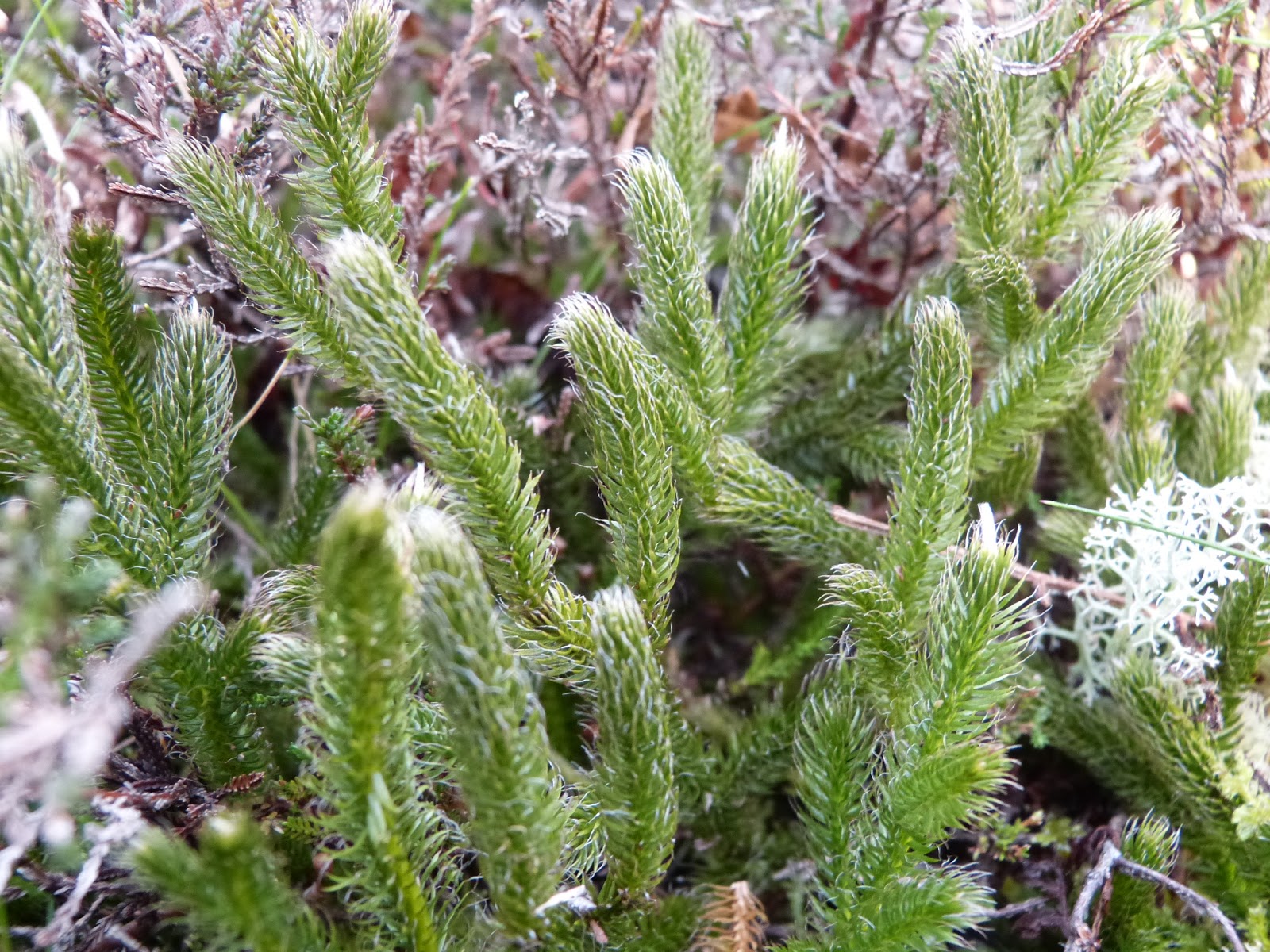
Lophozia bicrenata growing with Lycopodium clavatum among sparse Calluna heath on the former dry ski slope at Troedyrhiw (SO0703). I first saw the clubmoss here back in 2007 and it was pleasing to see it still thrives at the site.
 

Bryum violaceum on gravelly roadside soil, also at Troedyrhiw (SO0603); note smooth violet rhizoids and small tubers.


Scapania compacta and Andreaea rothii ssp. falcata on sandstone quarry waste at Merthyr Vale (ST0899).


In Cardiff and Bridgend I've not seen anything noteworthy, though it has been good to confirm Ulota crispa s.s. from several localities (I've been unable to find either U. intermedia or U. crispula to date, despite microscope checking of quite a few samples).

I'll aim to prepare an updated tetrad map in the next couple of weeks, which should show at least a few recording gaps being filled.

Monday, 12 March 2018

Mosses over the sea

There is very little land in ST1971 but this monad does include the outer portion of Penarth Pier. A trip with the family last weekend revealed six species growing on the wooden deck of the pier, directly above the sea at high tide but presumably elevated enough to limit the influence of salt. The species were Bryum capillare, B. argentuem, B. dichotomum, Ceratodon purpureus, Hypnum cupressiforme and Dicranoweissia cirrata.