Saturday, 13 February 2016

Cephaloziella conundrum continued

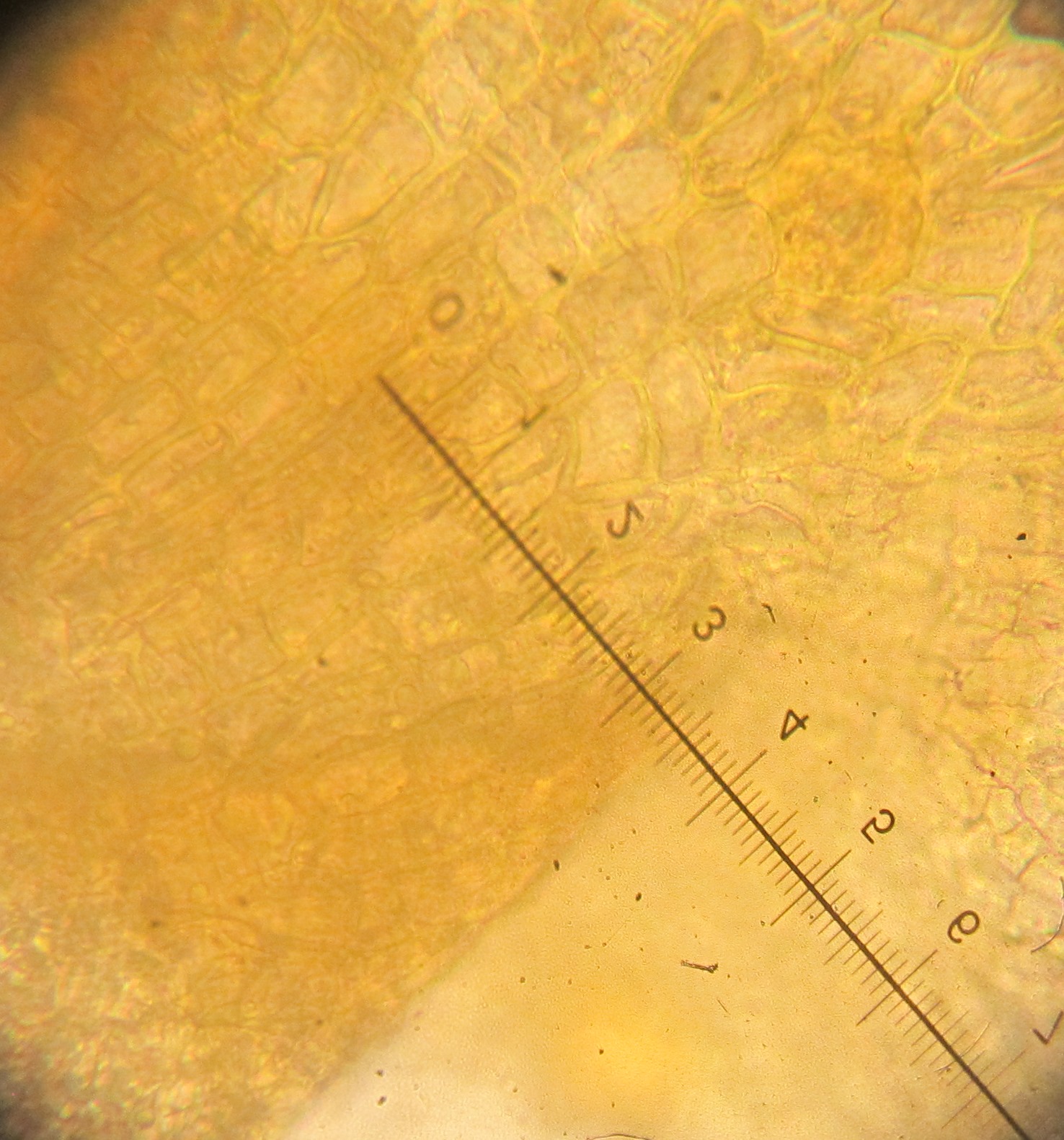
I’ve taken another look at the Kilvey sample and it's left me more baffled than I was after my hurried examination last night. Some bract tubes are definitely lobed and lack thickened cells towards the margins (as in integerrima), though some look perfectly good for calyculata! It’s not difficult to find 2-celled leaf lobe apices (rare in calyculata) and leaves that are divided >½ way (both good integerrima features). The largely calcifuge associate list also points to integerrima rather than calyculata, but as both are known occur on mine spoil, it's probably not worth putting any weight on this. I'm seriously wondering if both species might be present? I’ll send my samples on to Sam for expert opinion and will be keeping my fingers crossed. The image below is high resolution, which if you on to open full size and then save it, you can open it in your normal image browser and zoom in much more usefully than is possible in blogger.

Friday, 12 February 2016

More Old Castle Down limestone

I was back working on Old Castle Down today and took some time out to investigate another exposed limestone outcrop, this time on the north-facing side of the hill (SS899758).

The flora was broadly similar to that on a nearby west-facing outcrop I investigated a couple of weeks ago (see here), with the notable absence of Entosthodon pulchellus. A few additional species were noted, however, including Scapania aspera, Dicranum bonjeanii and Tortula subulata (photos of these three species below). A small patch of the latter was growing in a rock crevice, the elongated capsules betraying its presence - a new species for me.

Kilvey Hill liverwort query

I collected this troublesome liverwort from Kilvey Hill today. When I collected it, I thought it looked like Lophozia excisa, but it appeared to have odd-looking tubular bracts with undeveloped perianths inside. At home I looked up Lophozia, but Paton states the perianths in this genus are free, so I turned to the Cephaloziella key and ran it down to integerrima - very unlikely, but remotely possible. I can't help feeeling I'm missing something more obvious here, so any help appreciated as it's been a long week! I'll take some better images in natural light tomorrow if it's not resolved, but these will have to do for now. Growing on an acidic path-side earth bank, associates included C. divaricata, Fissidens bryoides, Brachytheciastrum velutinum, Solenostoma gracillimum, Ceratodon purpureus, etc.

Thursday, 11 February 2016

Back to the flood zone

For obvious reasons I haven't done much riparian recording this winter, but after a couple of almost dry days I thought I'd chance my arm on a lunchtime outing at Peterston-super-Ely (ST0876) today. Just west of the village is an easily accessible riverbank section with several mature trees, and happily the water level was low enough to expose the flood zone mosses.

Most of the expected species were there: Homalia trichomanoides, Cinclidotus fontinaloides and Plagiomnium rostratum (all on alder), Leskea polycarpa (on Sycamore) and a fair sized patch of Mnium marginatum on the silty riverbank. Best of all was a few small tufts of Orthotrichum sprucei on alder roots just above the water's surface. The location is two tetrads west of the St Fagans site for this species, but I'd imagine it will be present in the intervening tetrad too - as well as further upstream on the Ely. The arrow in the photo below shows the location.


Elsewhere there were a few riparian species in their more usual tarmac habitat: Dialytrichia mucronata, Didymodon sinuosus and D. nicholsonii. I searched a flailed hedge for Pylaisia without luck, though just below the regular flail zone was a good range of epiphytes - a habitat I'd not appreciated previously.

Pluck Lake

Pine Plantation near Pluck Lake

Reading Sam's post 'On Headless Hill' (great title for a thriller), I was reminded of a small colony of Leucobryum juniperoideum I found a couple of decades ago in the pine plantation near Pluck Lake in the Lower Swansea Valley. I haven't really been there looking for bryophytes in recent years, so H and I had a stroll in the woods around the lake this afternoon. Unfortunately no sign of the Leucobryum, and we didn't see any headline species, but I was impressed by how much the habitat has changed in the last 30 years or so. Pleurocarpous carpets dominate the woodland floor with lots of Hylocomium splendens and Pseudoscleropodium purum, occasional patches of Rhytidiadelphus loreus and Pleurozium schreberi, and a small amount of Plagiothecium undulatum. I was surprised by the amount of  Dicranum majus there. Back in the day when Steve Lavender was the Swansea University LSV Conservator, the woodland floor was rather sterile (but great for fungi in Autumn). What is really pleasing now is the way in which the habitat seems to be taking on the upland flavour of a surrogate Sessile Oak Woodland, much like the Neath Valley (and other) plantations have. Over the decades the pines have grown taller, allowing more light to get to the forest floor, and that has obviously provided better conditions for these bryophytes. I love the way these species colonise and transform conifer plantation habitats.

Dicranum majus growing with Dicranum scoparium, Pluck Lake Pine Plantation

Willows around the lake have a typical epiphyte flora, but we couldn't find any Colura. 

Wednesday, 10 February 2016

On Headless Hill

I love a good coincidence... This morning, Barry phoned to ask me about bryophytes and Killarney Fern gametophyte in a ravine in Carmarthenshire; at lunchtime I had a wander on Headless Hill (in the Welsh bit of the Forest of Dean) and stumbled across a large patch of Killarney Fern!  I'm sure I would have spotted it regardless of having it in my mind, as it covered nearly 150x30cm of the overhanging side of a large conglomerate block.  I usually find the gametophyte in slightly more humid localities, but it seems less desiccation-sensitive than the very rare sporophyte stage.  This part of Headless Hill was coniferised a few decades ago and the Trichomanes rock is now under a mature canopy of conifers (I think they are Fir).


Nearby were several well-rotted Oak/Beech stumps on which grew Leucobryum juniperoideum, Dicranum scoparium and a small tuft of a very curly-leaved Dicranoid moss that I had high hopes for.  Sure enough this turned out to be the long-awaited first VC35 record of Dicranum montanum, with very mamillose leaf cells and denticulate margins.  The straight-leaved D. tauricum is relatively widespread in the V-c, but for some reason the ecologically similar D. montanum remains extremely scarce in Wales.


Sunday, 7 February 2016

More asbestos

Just to tie together a couple of previous threads: I had a look at the asbestos roof of the boathouse at Dingestow Court Lake this morning and noted 13 species of moss.  These included a single nice cushion of Schistidium elegantulum with terete white hairpoints and stomata on the capsule (under the microscope).  It's a good time of year for checking S elegantulum capsules as the stomata are easiest to spot when the capsules are unripe.  They need to be sought on the very base of the capsule, where it curves up from the seta rather than on the parallel sides - there are 8(ish) on S elegantulum and 0 (or 1 sometimes) on S crassipilum.


Here is a series of pics I took a few years back for a Field Bryology article on Schistidium elegantulum ID that I never finished writing.  They show how one needs to chop off the base of the capsule, cut that base in half, and then examine the two halves just near the seta to spot the stomata.