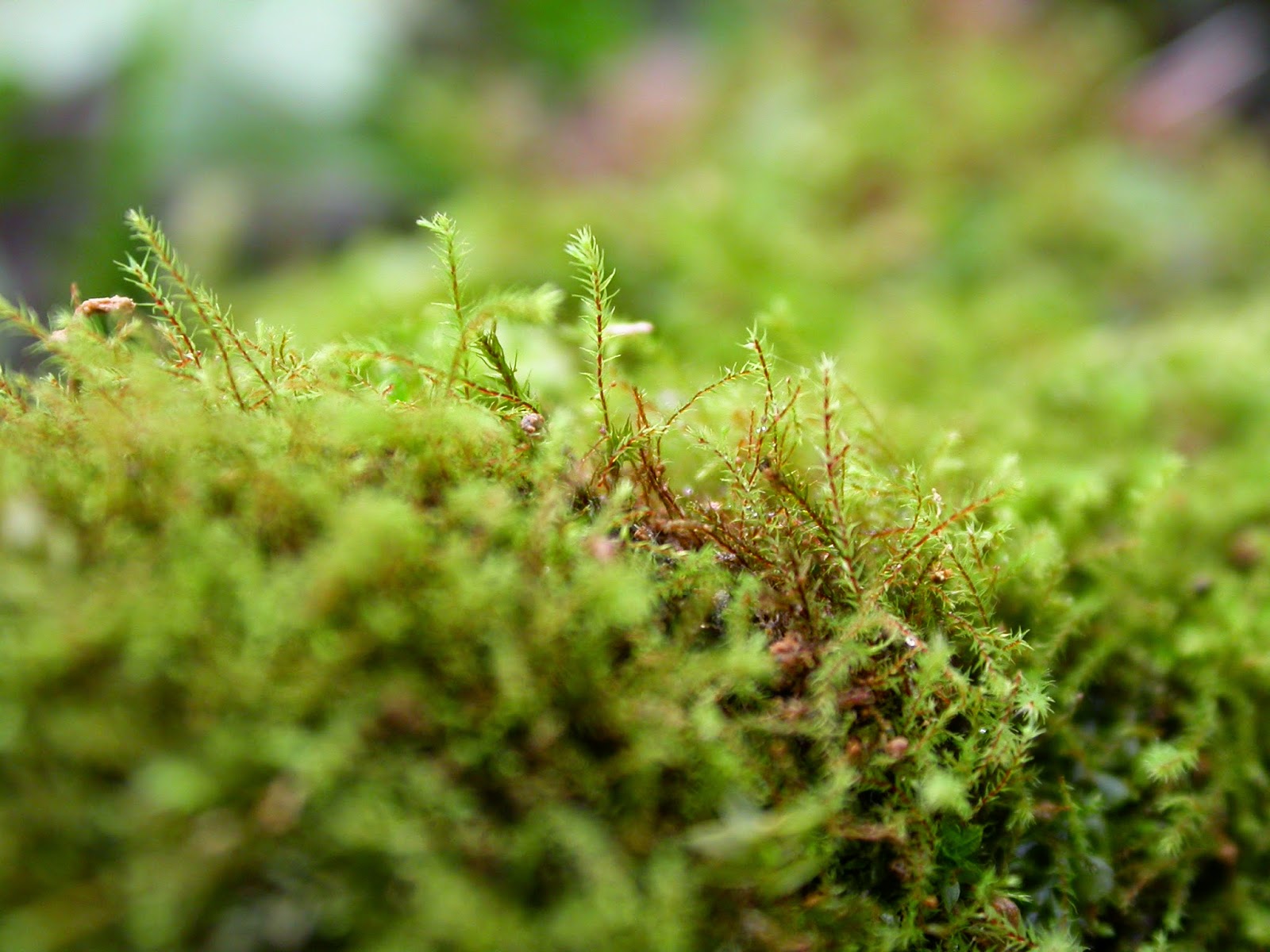
Showing posts with label Philonotis. Show all posts

Sunday, 7 April 2019

Rhossili Down

Tortula wilsonii (tbc) was the highlight of a wander around the n.w. section of Rhossili Down yesterday. It was growing as a few discrete, but dense patches totaling c.3 sqcm on soil ledges on a Brownstones Formation outcrop, Gower's oldest (Silurian) rocks SS41729038. Immediate soil associates included Sedum anglicum, Thymus polytrichus, Hypnum cupressiforme var. resupinatum, Trichostomum brachydontium, Pseudephemerum nitidum, Ceratodon purpureum, Cladonia sp. & Lepraria sp.

The same ledges held a few patches of Campylopus fragilis, at what is only the second site for Glamorgan.

Another Glamorgan first was Philonotis arnellii (tbc), which occurred as thinly scattered shoots on the steep mossy bank below Gorse and Bramble scrub, adjacent to the footpath at the base of the hill SS41649051. This is the site where I previously found Fissidens curvatus, which I failed to refind yesterday. Associates included Fissidens bryoides, Amblystegium serpens, Mnium hornum, Kindbergia praelonga, Richardia chamaedryfolia, Lophocolea bidentata & Weissia perssonii.

A small outcrop at the same location held Pterogonium gracile with Riccia subbifurca on the overlying thin soil crust. Anther colony of the Riccia was found higher up the hill on an ant hill.

All in all, it was a good afternoon, with a bonus ring Ouzel to boot (though not the views enjoyed by Charles & Hilary and Cwm Ivy the week before). The walk off the hill, following the stream below three spring heads, which held Sphagnum denticulatum & subnitens, plus Bryum alpinum & Sarmentypnum exannulatum, added some useful tetrad records that included Hookeria lucens, Plagiothecium denticulatum, Scpania undulata, Pellia neesiana, Campylium stellatum & Oxyrrhynchium speciosum.

Saturday, 27 October 2018

Puzzling Philonotis

I collected this somewhat nondescript Philonotis earlier in the week, during a visit to Pengwern Common, hoping that it might be caespitosa. Unfortunately it did not key out cleanly as anything, though the highly unlikely P. marchica came very close. So another one I'd welcome a second opinion of in the first instance. The presence of obvious distal papillae on the outer part of the leaf is more a feature of arnellii, though the leaves are not narrow or attenuated enough for that species. Perhaps more significant was the presence of axillary ovate bulbils on many shoots, this being a feature of marchica, with arnellii producing flagelliform axillary bulbils.

On a separate note it was good to record Leucobryum glaucum at several points across the site, this being a surprisingly localised species in Gower. I suspect it does not cope well with regular burning?

Sunday, 26 November 2017

Cwm Clydach (CCS)

It's been a while since I've indulged in any serious recreational bryology, so today it was good to get out and enjoy a 500m search of a tributary of the Lower Clydach River (centred at SN677066). Although this was an attractive little wooded valley, it was generally rather open and lacked any waterfalls or crags. Nevertheless a few noteworthy species were recorded including Odontoschisma denudatum (5 different logs scattered evenly along my walk - 4th vc tetrad), Barbilophozia attenuata (4th vcr), Dicranodontium denudatum (4th vcr), plus a potential candidate for Philonotis arnellii (below, top two images), though my sample although distinct, seemed bigger than I might have expected arnellii to be. An examination of the older leaves shows the cells in the outer 1/3 of the leaf has distal mammillae, but I need a more focused re-examination of my specimen to consider other perhaps more likely possibilities.

Below, Odontoschisma denudatum locations (also on log in top photo): 

Tuesday, 14 November 2017

Philonotis query

A record of Dicranella rufescens I made from a streamside at Garth Hill back in August 2014 had been playing on my mind for a while - partly because I haven't recorded this species since that time, and also because I was a rank beginner back then and liable to make even more mistakes than I do nowadays!

I located the specimen in my collection and it became immediately obvious, on getting it under the scope, that it was nothing like Dicranella. In fact it is a very skinny Philonotis with shoots just a little over 1cm tall. I struggle to comprehend how I came to the conclusion that it was D. rufescens - I guess the red stem, small size and habitat were enough to convince me.

I'm not entirely sure which Philonotis it is. The shoots are somewhat falcate-secund which, coupled with their skinniness, suggests it could be P. caespitosa. I've checked the older leaves microscopically and none seem to be pleated, or with recurved margins, which fits with caespitosa rather than weedy fontana - but I'm not sure the cells are big enough. The photos below might help - if not I'd probably best pass the specimen on to Sam.

Saturday, 17 October 2015

Cefn Bryn springs and flushes

area of basic flush at SS497899, the surrounding area was otherwise acidic
I took Alfie for a short walk around a randomly selected spring head on Cefn Bryn yesterday evening and found Scorpdium cossonii and Philonotis calcarea to be locally frequent is a small flushed area. This is now the third site on the common where I have encountered these two species and I've hardly looked elsewhere. Google aerials show there are many similar looking springs and flushes all around Cefn Bryn; how many have some form basic influence will be interesting to discover. I'm sure in time these two species will prove to be a little more widespread than our records suggest.
Scorpidium cossonii & Campylium stellatum
Scorpidium cossonii & bright green patches of Philonotis calcarea
Distribution of Scorpidium cossonii in Glamorgan

Saturday, 15 November 2014

Henrhyd, Mynydd-y-Gwair

The small gulley marks the Glamorgan-Carmarthenshire boundary (see
green line below), with Mynydd-y-Bettws windfarm on the Carms side
This afternoon I spent a good 1½ hours around 320m asl in the little bit of SN61Q that is part of Glamorgan (yellow area above), which proved more fruitful than I was expecting due to a good chunk being base-rich. My highlight was a 60m2 patch of Philonotis calcarea (the red patch), the most prominent associates including Palustriella falcata¸ Anagallis tenella and Campylium stellatum. Also there were some lovely wefts of Archidium alternifolium on the adjacent heath growing along with species such as Scorpidium revolvens, Scapania irrigua, Riccardia chamedryfolia, Aneura pinguis and Didymodon fallax.
Philonotis calcarea
Scorpidium revolvens
Archidium alternifolium

Wednesday, 12 November 2014

Philonotis arnellii

The books make out that Philonotis arnellii is a featureless moss that is easily confused with the very much commoner P. fontana.  That is true to an extent, but it's one of those species that is really quite distinctive when you see the real thing: when you think you've found it, you've got P. fontana and it's only real P. arnellii when you know you've got something different.  Most colonies I have found are on earthy ledges alongside rivers, perhaps flooded once every few years, but I've also seen it in the uplands on ledges and occasionally on flushed lane banks (perhaps like Barry's recent one).  I haven't found convincing material on forestry tracks, where juvenile P. fontana is frequent and confusing. 

Look for relatively dense patches of consistently very small shoots with very narrow leaves, expect there to be abundant deciduous branchlets (there usually are) and look for fertile buds (with even longer, narrower leaves) with a lens.  A microscope is needed to check the cell mamillae: look at mature leaves on the lower, brown sections of the stem.  Here are four photos from a large colony near Brechfa in central Carms.