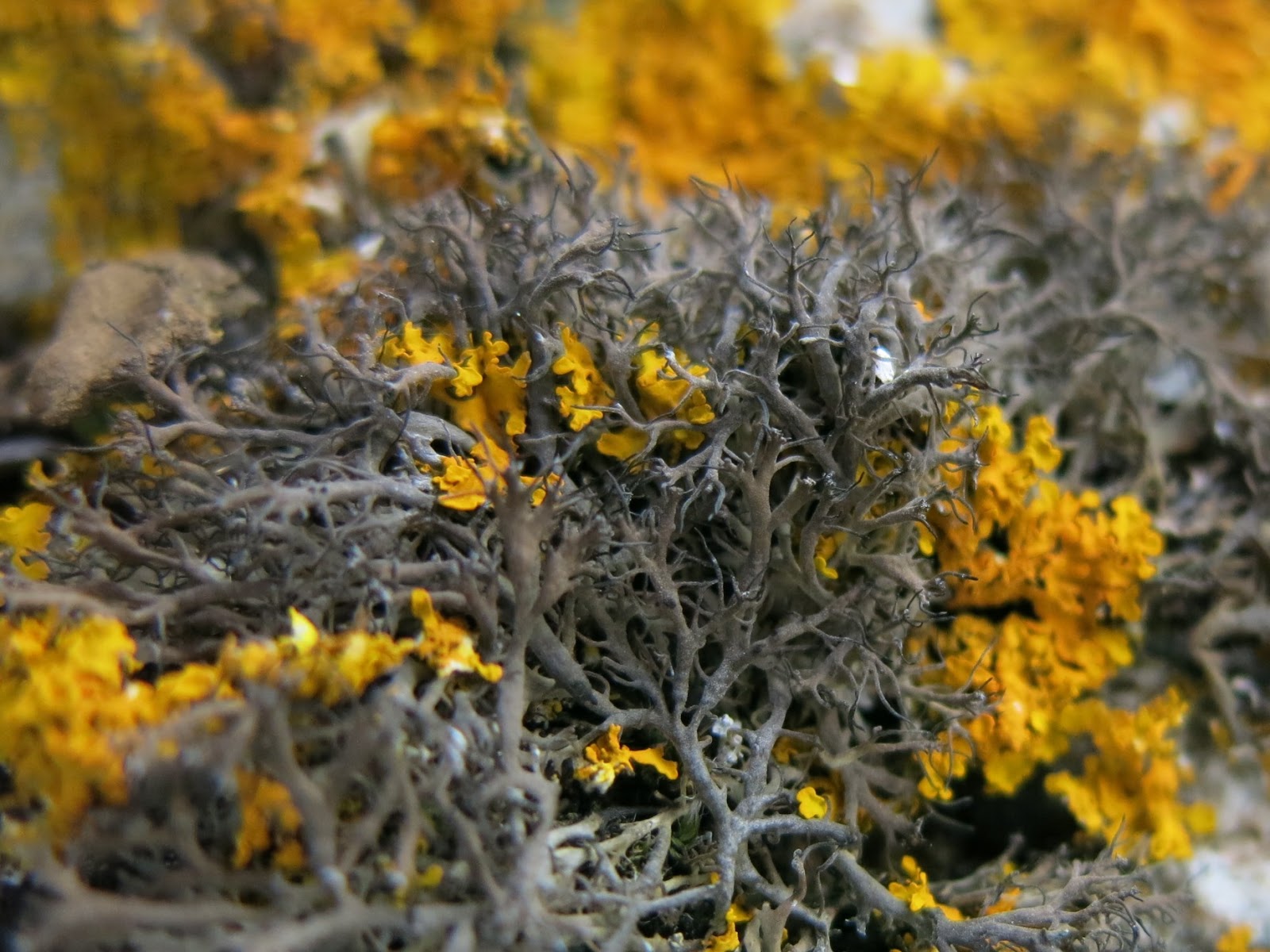
Showing posts with label nanum. Show all posts

Saturday, 6 May 2017

A weekend on Lundy - mosses and liverworts

Clare and I spent the bank holiday weekend on the magical Lundy Island, sailing from Bideford after dropping Bea and Johnny with their grandparents in Sussex.  South Wales was visible from Lundy (when it wasn't raining), so perhaps it isn't stretching the Blog title too much to mention some of the bryophytes I bumped into during our visit.  Clare enjoys walking for walking's sake, whereas I walk to get to recording sites, but we had a good compromise where Clare strode between headlands and waited with a book whilst I made a few stops in between; we did plenty of walking together too.


On our first day included a walk up the west coast of the island as far as the Halfway Wall.  The path down to the Battery produced Anthoceros punctatus (photo) and Tritomaria exsectiformis (photo), whilst rocky heathland a little further north held Kurzia sylvatica.  A flushed area (photo) with Bryum alpinum also supported Fossombronia sp with violet rhizoids, which I suspect is F. maritima; I'm growing some on in a tube in the hope of sporophytes.  Pogonatum nanum (photo) was fruiting beautifully on a bank nearby.


Our second day was marred by heavy rain in the morning, but we ventured out a few times along the east side of the island.  Bryological highlight was Frullania teneriffae (new for VC4) alongside Scapania gracilis in the VC Quarry (photo).  Exploration of the wooded Millcombe valley produced Epipterygium tozeri, Pohlia lutescens and Plagiochila asplenioides, whilst Schistidium rivulare was a surprise on rocks in the Quarter Wall Pond.


Our third and final day involved a stomp along 'The High Street' to the north end of the island (4 km away from The Village) followed by a walk back along the east side.  Lepidozia cupressina (photo) and Dicranum scottianum (photo) grew together on a tor just south of Gannets Coombe - like Dartmoor in miniature - and there were Cephalozia connivens and C. lunulifolia nearby.  Salt-sprayed turf near the northern lighthouse held Hennediella heimii, and a Bryum nearby looked interesting but was unfortunately non-fertile.  Finally, an exploration of Landing Bay while we waited for the boat back to the mainland produced Schistidium maritimum and Weissia perssonii at last: most of the island is too steep to allow descent to the maritime areas favoured by these species.


I don't actually know how many of the 100+ species that I recorded (with 8-fig GPS readings) were new for the island.  The BBS dataset seems extremely incomplete, especially for liverworts, with some broad-date 20th century records and a list made by Mark Pool in 1997; I added nearly 30 species to the hectad tally according to the BBS data.  However, Jean Paton's data from her visit in 1975 does not appear in the BBS dataset and several of my 'additions' were already recorded by her (unsurprisingly!), and Jean spotted several liverwort during her "few hours" on the island that I missed.  The Lundy Field Society reports may include other liverworts, but the issues that I looked at didn't have anything.  Mosses seem to be even more under-recorded, and the only reference I can find is a list from 1959 with IDs by Michael Proctor, and it is that list which forms the basis of the BBS data.  I will, of course, make sure that my records go to the BBS and the Lundy Field Society.

As well as the bryophytes, we saw Lundy's famous Lundy Cabbage (none of the plants by the paths were in flower unfortunately), Balm-leaved Figwort, Primrose Peerless and Ophioglossum azoricum.  Star lichens were Teloschistes flavicans and Anaptychia ciliaris subsp mamillata.  Bird highlights were the Lundy rarities Yellowhammer and Stock Dove, which I found during our wanderings, and there were various Warblers around, Black Redstart, Pied Flycatcher, Whimbrel etc.  Lundy really is a fabulous place for a wildlife-rich holiday!


Thursday, 4 December 2014

A few recent pics

A few pics of samples collected last week:
Brachytheciastrum velutinum (Velvet Feather-moss) at Swansea Vale
I couldn't relocate Sam's Scopelophila in a 10 minute search,
but will try again next time I'm passing. 
Pogonatum nanum (Dwarf Haircap) at Rhossili Down 30-Nov-14
Weissia perssonii (Persson's Stubble-moss) at Rhossili Down 30-Nov-14

Sunday, 30 November 2014

Rhossili Bay

Some casual observations during a walk to the Old Rectory at Rhossili this afternoon produced two new species for me: Pogonatum nanum and Weissia perssonii, both being found on the fine loamy soils around Devonian Sandstone & Conglomerate outcrops.  The Weissia was locally frequent and was fruiting freely. Although the capsules were unripe, pulling them apart under the microscope revealed a rudimentary peristome and the strong costa with elongated, smooth adaxial cells.
Pogonatum nanum
Also noted were a few robust patches of Saccogyna viticulosa in one of the gulleys, a few patches of Riccia subbifurca on anthills otherwise dominated by Ceratodon and a little Reboulia hemisphaerica among the Rectory walls assemblage. Given these really were just casual observations (I was pushing Alfie in his ‘doggyhut’ most of the time!), there must be scope for plenty other discoveries along this section of coast, which is geologically very different from much of Gower’s Limestone coast.
Riccia subbifurca
ant hill in foreground location of R. subbifurca