Showing posts with label Pterogonium. Show all posts

Tuesday, 7 February 2017

Hillend ORS

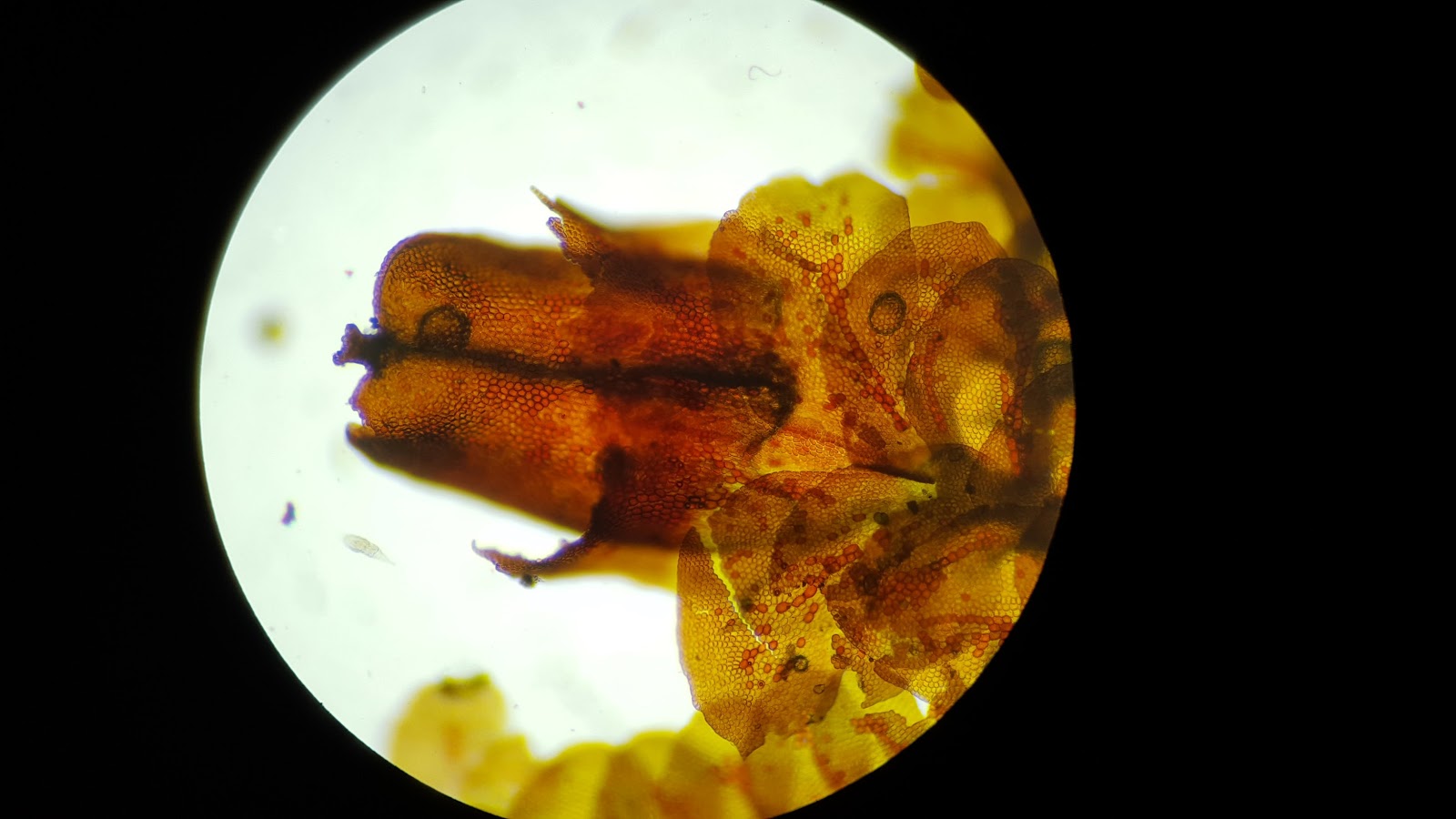
Today I finally checked a few specimens I brought back from a 1 hour visit to Hillend, at the northern end of Rhossili Down,on the 4th (the area searched shown above). There is a nice rocky ridge in this area, marking the geological boundary of the Brownstones formation and the Upper ORS. The Frullania on the rocks looked interesting and one of my samples had a mix of tamarisci, dilatata and microphylla var. microphylla, the latter new for the county. I'm pretty confident this is correct and whilst a barely detectable fragrance put a little doubt in my mind, everything else seems spot on. The flat leaves seem to be a good field feature. Occasional burgundy patches of Frullania were dotted around the rocks and whilst I'm not 100% sure which rock my sample came from, I suspect it was that shown in the above photo (approximately SS41939097). I'm sure further searches will reveal further patches with microphylla mixed in. Other species noted included some nice patches of Grimmia trichophylla, Pterogonium gracile and Scleropodium touretii.
G. trichophylla
coastal lichens were much more prominent than bryos.
rocks with Pterogonium, Isothecium myosuroides and Hypnum cupressiforme var. resupinatum

Saturday, 4 June 2016

A trip to north-east Wales

Work took me to Clwyd for 2 nights and 1 day.  The day was spent mapping some very nice limestone grassland, with 50+ Frog Orchid and some Small Pearl-bordered Fritillaries (eventually photographed and IDed, to my disappointment as I was hoping for Pearl-bordered!).  Both evenings were spent on the stunning limestone escarpment of Creigiau Eglwyseg/Trevor Rocks, whilst a pre-breakfast wander by the River Dee just upstream of Llangollen produced a completely different bryoflora.


Eglwyseg is phenomenally spectacular, but its bryoflora doesn't quite live up to its appearance (or to its rich lichen flora).  Some areas, such as World's End, have been regularly worked by bryologists and have been visited by BBS groups, and these hold a few Nationally Scarce species, such as Entosthodon muehlenbergii and Plagiopus oederianusDitrichum flexicaule s.str had been recorded in the past, and the most recent BBS visit revealed Schistidium robustum and Entodon concinnus, but the site looks ideal for rarer things: why aren't Pennine specialities such as Encalypta rhaptocarpa, Mnium thomsonii and Zygodon gracilis there?!  My two sites, to unknown areas in the south of the escarpment, produced a few Nat Scarce mosses, such as D. flexicaule, Pleurochaete squarrosa and potential S. robustum, as well as Encalypta vulgarisSchistidium elegantulumBarbilophozia barbataTortula subulata and an excellent tufa spring with Philonotis calcarea, but I don't think there are any surprises among my scant collections for checking.  Any bryo walk when I spent my time photographing lichens must be bryologically disappointing!

Barbilophozia barbata among Dicranum scoparium, and Encalypta vulgaris with a view!


The stretch of the Dee that I checked was also disappointing, with the sunny riverside rocks far too shaded by trees and rank vascular plants, and no sign of Grimmia laevigata or G. ovalis (I hope they are still nearby...).  Equally down-curved Pterogonium gracile and Scleropodium cespitans were perhaps the most notable species, although a Grimmia lurking among the Pterogonium might be better.

Downcurved Pterogonium gracile and Scleropodium cespitans by the Dee. 

My daytime survey, in the Eryrys area, produced Entodon concinnus, Didymodon acutus and Pleurochaete squarrosa.

Pleurochaete squarrosa in the Eryrys area.

Both walks on Eglwyseg were enlivened by 100s of Plutella xylostella: part of the massive national influx of this moth.
Plutella xylostella with Dinas Bran in the background.

Thursday, 15 October 2015

Wednesday, 14 October 2015

Bessie's Meadow

This afternoon I decided to try and relocate the Pterogonium gracile and Hedwigia ciliata, both recorded by Quentin in 1969 at Bessie's Meadow at the north end of Rhossili Down. My other aim was to give the paltry 28 species tetrad total for SS49A a boost. As I started the walk up the hill I was amazed to find some healthy patches of Pterogonium on the very first rock I stopped to look at in the middle of the path (photos below)... result! It turned out that small colonies were scattered across the boulder field, especially in the lower parts.
plants in photo below part of the colony
on the largest rock in the photo above 

The highlight however was a boulder supporting scattered patches of Porella obtusata, new for the county. The large tongue-shaped lobules with larger central cells are diagnostic characters, but the habitat on siliceous boulders seems to be another helpful pointer.

As usual, I have a batch of other samples I've yet to check, the most promising perhaps being Frullania crusts which have the potential to contain fragifolia [sadly not, tamarisci was all I could find]. I also collected a few Grimmia samples in the hope of finding lisae, though I'm expecting these will be trichophylla [they were], plus there was an interesting tiny Fissidens with ripe fruit and long perichaetal leaves which looked interesting [see posting above]. Non-bryo highlights were 3 Dartford Warblers in an area where they've not been recorded previously. All in all it was a productive couple of hours and definitely worth another visit. The boulder field is extensive and I only managed to look at a small sample of it, plus there's Quentin's Hedwigia still to relocate.

Saturday, 20 December 2014

Sun-drenched crag

Buckland Hill above Bwlch (between Brecon and Crickhowell) is a bracken infested common, part of which has been planted with conifers.  It doesn’t look very appealing, but there are some tiny east-facing crags, which I have looked at on hundreds of occasions when driving by, which could have a few bryo species not found elsewhere in the tetrad.   Had day off work today so decided to wander the 2km from home to have a look – 15 minutes of smashing through bracken, gorse and bramble on the common and I arrived at the crags. 


The flat tops of the crags were enriched by the few stock that graze the area and the vertical faces weren't too promising.  I could see some more mossy rocks below the base of the crags so clambered down and found some nice patches of Pterogonium gracile, the tiniest patch of Hedwigia stellata and, rather unexpectedly on a damp area of the vertical face, a couple patches of Campylopus fragilis (don’t see it very often in VC42 – mainly upland rock ledges – is it mainly coastal in Glam?) together with a bonus patch of Tortella bambergeri, so it was probably just about worth all the scratches.


Elsewhere on the hill there were a few tiny rock exposures – again mostly highly enriched with dung, but a couple had Scapania compacta.   With River Usk running through southern part of this tetrad it will probably turn out to have quite a high species total, despite about 3/4 of the area being improved grassland.