I'm suspecting this odd structure on the rhizoids of Bryum pseudotriquetrum (or possibly B. pallescens, which I was puzzling over it when I spotted them, so must check the id) might be a gall? If anyone knows anything about these or what else it might be, I'd be interested to find out. Collected at Baglan Burrows yesterday, from one of the WTSWW Distichium inclinatum trial management plots. For ref the diameter of the internal stalked sphere is 25μm and the external surface of the swollen club-shaped structures (several visible in lower image) appeared papillose.
Showing posts with label Bryum. Show all posts
Monday, 25 November 2019
Friday, 29 March 2019
On the relationship between the rare moss Bryum marratii Wilson and a dune aquifer
Just a short note following on from the paper last year on Bryum marratii at Whiteford. Posted here as a useful reference point. Im sure you all have the journal access but if not and you want a copy drop me an email.
https://www.tandfonline.com/doi/abs/10.1080/03736687.2018.1551591?journalCode=yjbr20
Callaghan & Farr (2019) On the relationship between the rare moss Bryum marratii Wilson and a dune aquifer, Journal of Bryology, 41:1, 59-62, DOI: 10.1080/03736687.2018.1551591
Wednesday, 26 December 2018
Declining acidophiles
Just before Christmas I spotted three uncommon mosses at Dingestow: Plagiothecium latebricola was new for the area (bryophyte number 242), Bryum moravicum was the 2nd Dingestow record and the first in VC35 since 2008, and Aulacomnium androgynum used to be frequent at Dingestow in 1999/2000 but was last seen in VC35 in 2009. The Plagiothecium is remarkably small and easily ignored/overlooked, but formed a dense cover over ca. 30 square cm of a huge log.
Saturday, 24 November 2018
The unusual inter-tidal niche of the rare moss Bryum marratii Wilson
Just thought id share a link to the recent paper about Bryum marratii based on study sites in south Wales as useful to have it on the blog too. It was great working with Des, although the 4am start to film a high tide submerging the mosses was a bit of a struggle ! Hopefully there are more collaborations in the pipeline. Im sure you have all seen it but worth adding to the blog anyhow. There is a follow up paper in press and ill share that too. If you need an electronic copy drop my a line at garethf@bgs.ac.uk
Link to Journal of Bryology
Research Gate
You Tube Video
Link to Journal of Bryology
Research Gate
You Tube Video
Labels:
Bryum,
marratii,
Salt marsh,
sea level,
whiteford.
Wednesday, 14 November 2018
Slim pickings in the Vale
Parts of the Vale are still chronically under-recorded for bryophytes. The latest VC41 tetrad map shows a particularly bad white hole in SS97 and ST07:
Looking at the OS maps and aerial photos for some of these unrecorded tetrads it became obvious why no bryologists had bothered to record there - a mix of improved grassland and large arable fields, with a few lanes passing through and a distinct lack of woodland. Challenging territory indeed, but feeling rusty after the summer hiatus it seemed a good place to kick off the bryophyte recording season when I had a day off work last week. Not too many species to tax my brain.
I visited three tetrads on a day of sunshine and showers, with some lengthy downpours meaning time was lost while sheltering in the car. I started off at Llysworney, which had a bit more habitat variety than some of the other areas thanks to the village streets and walls, and Worney Wood - a new wood planted by the Woodland Trust. The woodland would presumably have been a couple of boring rye grass fields until it was planted a few years ago. Now it supports young trees quite rich in epiphytes, though with nothing of note except for some Porella platyphylla and Didymodon sinuosus on an old field boundary Ash. Tetrad SS97S has now moved along from 3 to 37 bryophyte species.
Much of the day was spent walking the lanes and footpaths in SS97R, which at least succeeded in putting this tetrad on the bryological map with 49 taxa recorded. It was a bit of s struggle though. The arable fields had been recently sown with winter cereals, but a sample collected from a small area of unploughed margin produced three tuberous Bryum species: B. rubens (large knobbly red tubers), B. ruderale (large tubers & papillose violet rhizoids) and B. violaceum (smaller tubers & smooth violet rhizoids - photo below).
To end the day there was time for a brief stop at Llanmihangel churchyard before the heavens opened again. This small churchyard, tucked into a valley bottom, proved to be the nicest spot of the day, and produced a few species not seen at the earlier sites: Cirriphyllum crassinervium, Lophocolea bidentata, Thuidium tamariscinum and Plagiochila asplenioides (the latter growing on a stone grave). SS97V was another tetrad that hadn't been recorded previously, so all 20 species were new.
A feature of the day was the abundance of Anomodon viticulosus on laneside walls and a few hedgerow tree bases. This species is proving frequent in the lime-rich Vale and I look forward to putting more dots on the map on future visits.
I enjoyed the day despite making only 128 bryophyte records and failing to take any tetrads past the 60 mark. No doubt a spring visit would add a few more Orthotrichum, Ulota, etc, but is it worth the effort? I think the time would probably be better spent elsewhere.
Looking at the OS maps and aerial photos for some of these unrecorded tetrads it became obvious why no bryologists had bothered to record there - a mix of improved grassland and large arable fields, with a few lanes passing through and a distinct lack of woodland. Challenging territory indeed, but feeling rusty after the summer hiatus it seemed a good place to kick off the bryophyte recording season when I had a day off work last week. Not too many species to tax my brain.
I visited three tetrads on a day of sunshine and showers, with some lengthy downpours meaning time was lost while sheltering in the car. I started off at Llysworney, which had a bit more habitat variety than some of the other areas thanks to the village streets and walls, and Worney Wood - a new wood planted by the Woodland Trust. The woodland would presumably have been a couple of boring rye grass fields until it was planted a few years ago. Now it supports young trees quite rich in epiphytes, though with nothing of note except for some Porella platyphylla and Didymodon sinuosus on an old field boundary Ash. Tetrad SS97S has now moved along from 3 to 37 bryophyte species.
Much of the day was spent walking the lanes and footpaths in SS97R, which at least succeeded in putting this tetrad on the bryological map with 49 taxa recorded. It was a bit of s struggle though. The arable fields had been recently sown with winter cereals, but a sample collected from a small area of unploughed margin produced three tuberous Bryum species: B. rubens (large knobbly red tubers), B. ruderale (large tubers & papillose violet rhizoids) and B. violaceum (smaller tubers & smooth violet rhizoids - photo below).
To end the day there was time for a brief stop at Llanmihangel churchyard before the heavens opened again. This small churchyard, tucked into a valley bottom, proved to be the nicest spot of the day, and produced a few species not seen at the earlier sites: Cirriphyllum crassinervium, Lophocolea bidentata, Thuidium tamariscinum and Plagiochila asplenioides (the latter growing on a stone grave). SS97V was another tetrad that hadn't been recorded previously, so all 20 species were new.
A feature of the day was the abundance of Anomodon viticulosus on laneside walls and a few hedgerow tree bases. This species is proving frequent in the lime-rich Vale and I look forward to putting more dots on the map on future visits.
I enjoyed the day despite making only 128 bryophyte records and failing to take any tetrads past the 60 mark. No doubt a spring visit would add a few more Orthotrichum, Ulota, etc, but is it worth the effort? I think the time would probably be better spent elsewhere.
Labels:
Anomodon,
Bryum,
Didymodon,
platyphylla,
Porella,
sinuosus,
violaceum,
viticulosus
Wednesday, 28 March 2018
The Gloucestershire Bryophyte group at Llangattock
The Glos bryology group arranged an out-of-county day at the
eastern end of Llangattock this year, to give us a bit of a change from the
usual neutral / calcareous woodlands and grasslands of our own county. 7 of us
turned up at the quarry car park on a chilly Sunday morning in March, to
explore the conical spoil heaps, fallen boulders and quarry walls of the area.
We didn’t get very far (as usual!), but still managed to record 97 species for
the square SO2015.
Highlights of the day were Racomitrium canescens on the grassland at SO20241554, and Bryum elegans on a fallen boulder at the base of the quarry (SO20491535). Both are new species for VC 42.
| Racomitrium canescens |
| Bryum elegans in situ |
![]() |
| Bryum elegans: Note reflexed hair-points and border of long narrow cells |
We spotted some lovely patches of Sanionia uncinata sheltered
within the walls of an old building and scattered throughout the grass on the
spoil heaps above.
The
Climacium dendroides was looking
particularly photogenic and I just couldn’t resist...
We saw Philonotis
calcarea, new to many of us, and Sharon Pilkington unintentionally
collected Philonotis arnelli in
amongst another specimen. Sharon also spotted Distichium inclinatum on the outside wall of the derelict building
– there were old capsules which were clearly inclined, and new ones coming
which I will go back and photograph if I get a chance.
Further to the west, David Hawkins found Calliergon cordifolium in shallow pools on the quarry bottom, but sadly the inevitable rain arrived about then, so we have no photos.
Finally, not to forget the liverworts, some beautiful Ptilidium ciliare on rocks amongst the
grassland to the west of the spoil heaps:
And Tritomaria quinquedentata on the spoil heaps amongst the grass and other
bryophytes:
All in all, we had a fantastic day and are planning a return
trip soon for those who couldn’t make the first visit.
Tuesday, 13 March 2018
Out and about
I've had a lean winter recording-wise, but at least February proved to be reasonably productive. Most records were made around Cardiff, Bridgend and Merthyr Tydfil, during stop offs on the way home from work trips. Nothing remarkable has been recorded but minor highlights have included:
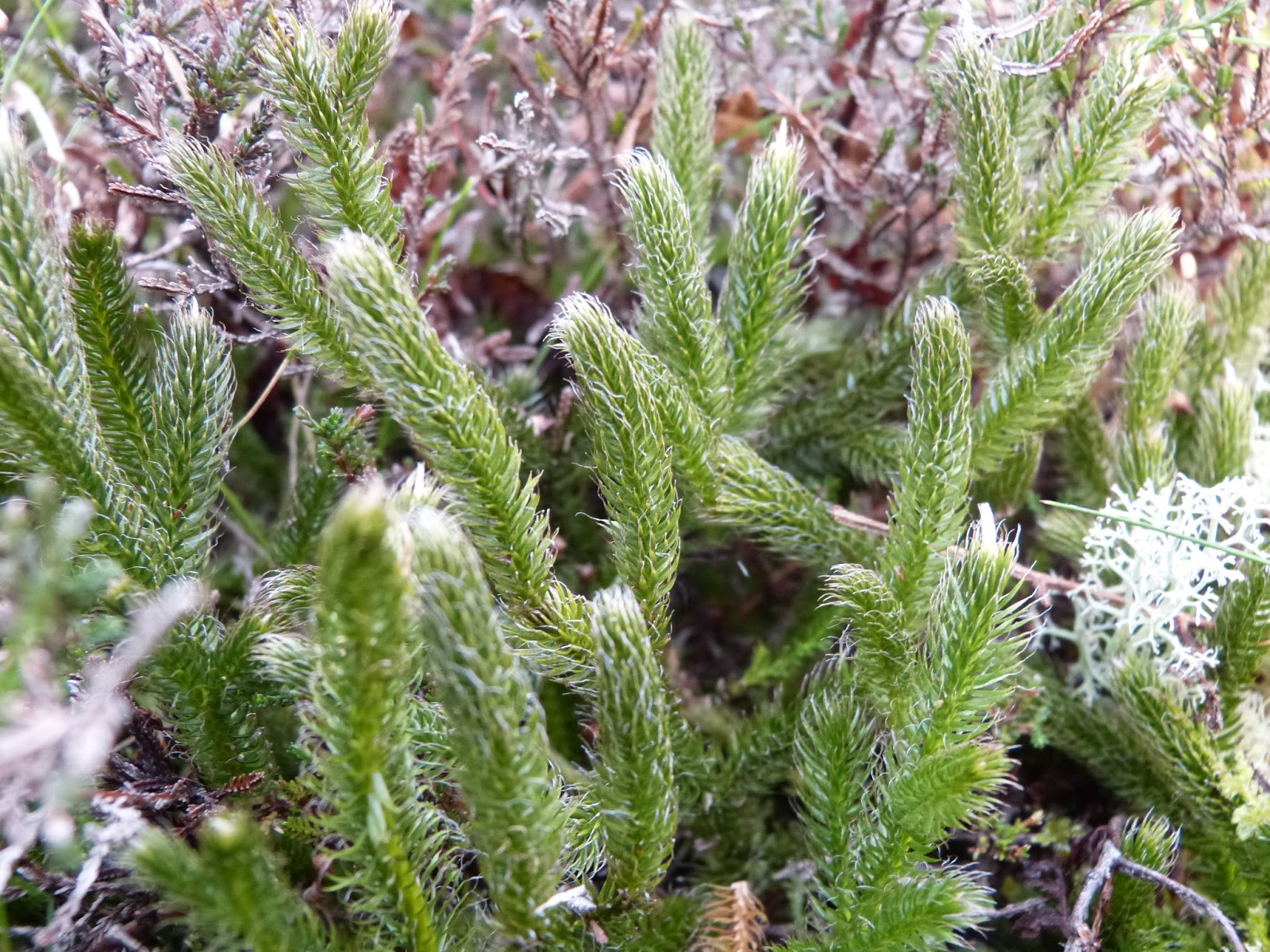
Lophozia bicrenata growing with Lycopodium clavatum among sparse Calluna heath on the former dry ski slope at Troedyrhiw (SO0703). I first saw the clubmoss here back in 2007 and it was pleasing to see it still thrives at the site.
Bryum violaceum on gravelly roadside soil, also at Troedyrhiw (SO0603); note smooth violet rhizoids and small tubers.
Scapania compacta and Andreaea rothii ssp. falcata on sandstone quarry waste at Merthyr Vale (ST0899).
In Cardiff and Bridgend I've not seen anything noteworthy, though it has been good to confirm Ulota crispa s.s. from several localities (I've been unable to find either U. intermedia or U. crispula to date, despite microscope checking of quite a few samples).
I'll aim to prepare an updated tetrad map in the next couple of weeks, which should show at least a few recording gaps being filled.
Lophozia bicrenata growing with Lycopodium clavatum among sparse Calluna heath on the former dry ski slope at Troedyrhiw (SO0703). I first saw the clubmoss here back in 2007 and it was pleasing to see it still thrives at the site.
Bryum violaceum on gravelly roadside soil, also at Troedyrhiw (SO0603); note smooth violet rhizoids and small tubers.
Scapania compacta and Andreaea rothii ssp. falcata on sandstone quarry waste at Merthyr Vale (ST0899).
In Cardiff and Bridgend I've not seen anything noteworthy, though it has been good to confirm Ulota crispa s.s. from several localities (I've been unable to find either U. intermedia or U. crispula to date, despite microscope checking of quite a few samples).
I'll aim to prepare an updated tetrad map in the next couple of weeks, which should show at least a few recording gaps being filled.
Monday, 12 March 2018
Mosses over the sea
There is very little land in ST1971 but this monad does include the outer portion of Penarth Pier. A trip with the family last weekend revealed six species growing on the wooden deck of the pier, directly above the sea at high tide but presumably elevated enough to limit the influence of salt. The species were Bryum capillare, B. argentuem, B. dichotomum, Ceratodon purpureus, Hypnum cupressiforme and Dicranoweissia cirrata.
Wednesday, 17 January 2018
Surprising urban wall moss
My most surprising bryo find of the winter so far has been Ptychomitrium polyphyllum growing just a stone's throw from the Butterfly Conservation Wales office in Hafod, Swansea. I first noticed a cushion of this moss growing on the sandstone coping of a sloping wall back in November, but only remembered today to take my camera along to get a few photos. I must have walked past it countless times last year before I noticed it. The moss is in the foreground of the photos below. It is close to a busy road junction and must experience pretty high levels of nitrogen pollution.
I noticed today that as well as the large fruiting cushion there is a small non-fruiting cushion nearby (on the right-hand side in the photo below left).
The associates are all mundane species: mostly Grimmia pulvinata with some Bryum capillare and a tiny amount of Tortula muralis. The rest of the wall is almost devoid of moss apart from a few scraps of G. pulvinata here and there.
I've not seen this moss in an urban situation before, but perhaps it isn't so unusual. Sam's Pembrokeshire flora mentions its persistence on imported rocks at County Hall in Haverfordwest, shwoing it can survive some pollution.
Labels:
Bryum,
capillare,
Grimmia,
muralis,
polyphyllum,
Ptychomitrium,
pulvinata,
Tortula
Sunday, 14 January 2018
A few bits and bobs from the Usk
I had a quick walk along the Usk at Abergavenny at lunchtime
on Friday and it occurred to me that I hadn’t seen Hennediella stanfordensis for some time. Water levels were low enough to be able drop
down onto rivers edge and peer at the eroding banks. Bank erosion
due to recent winter floods meant that there were relatively few areas with any
bryophyte cover and it took me some time to find a few small patches of Hennediella although were some
nice colonies of Bryum gemmiferum here
and there.
Not sure I have ever looked
at Hennediella under the microscope –
the few teeth near the leaf tips are very distinctive.
Male and female Lunularia
seem frequent along this part of the Usk – in the past I have kept an eye on mixed
patches, but haven’t yet seen any sporophytes.
Further upstream past the hospital is a stoney bank where Bryum donianum grows – I am not sure I
have ever looked at donianum under
the microscope either, so I pulled a couple of leaves off – in the field the thick
margin joining the nerve is obvious, but the tiny teeth probably less so.
Bonus species included a common sandpiper, presumably the
same bird I had seen further upstream earlier in the week, a kingfisher and
there were also a few snowdrops flowering on a nearby roadside.
Labels:
Bryum,
donianum,
Hennediella,
stanfordensis
Subscribe to:
Posts (Atom)