Showing posts with label subbifurca. Show all posts

Wednesday, 25 April 2018

Scilly exotics

I've enjoyed other recent holiday reports on this blog so I hope you'll indulge me writing another one, from a bit closer to home...

It's a bit of a cliche to say that the Isles of Scilly feel like a world away from mainland Britain, despite being just 28 miles off the end of Cornwall. But after my first visit to the archipelago earlier this month I could hardly disagree with the sentiment. The flora in particular felt very exotic, with the bryophytes being no exception. Many species that are common in South Wales were scarce, as would be expected on a series of small, remote islands. The epiphyte flora in particular seemed impoverished, with most tree trunks being lichen-dominated instead - even Frullania dilatata was somewhat localised. This was adequately compensated for by the plethora of exotic species (liverworts mostly) which are scarce or absent on the mainland, some of which are imports from the Southern Hemisphere and some possibly from the Mediterranean.

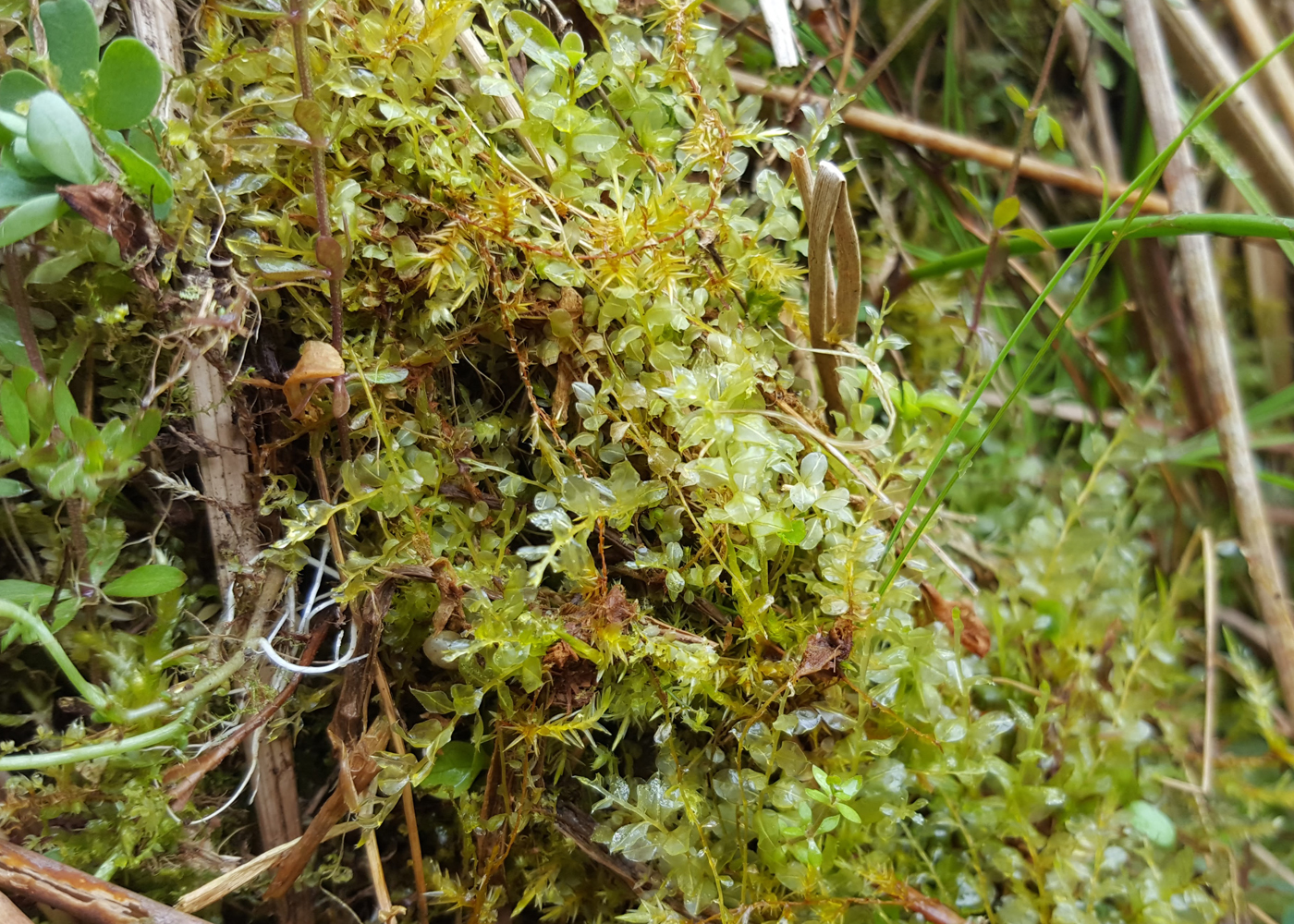
The fun started at Lower Moors nature reserve on St Mary's, where I got excited by an extensive yellowy patch of Telaranea murphyae growing by a path to a bird hide (photos below). I thought this liverwort was restricted to Tresco but I later discovered that the population at Lower Moors had been found in 2003. It appears that the taxonomic position of T. murphyae remains somewhat uncertain; it has not been found as a native in the Southern Hemisphere and was described new to science from Tresco, though it may just be a form of T. tetradactyla. A potentially new population was found later in the week by a path near the lifeboat station at Hugh Town (lower photo).

The excitement really started on Tresco, where a flowerbed in the Abbey Gardens was dotted with the lovely rosettes of Riccia crystallina intermingled with numerous Sphaerocarpos plants (photos below). I collected three Sphaerocarpos samples and after a few days incubation each produced mature spores to enable species identification; pleasingly both species were represented with two samples being S. michelii (spore photo bottom left) and one S. texanus (bottom right).
 

Telaranea murphyae was seen in a few locations within the gardens, along with Lophocolea semiteres and L. bispinosa, but was much more abundant along Abbey Drive where extensive yellow sheets of it covered the ground wherever there was shade from trees (upper photos, below). Growing with it was Calyptrochaeta apiculata (lower photos) - in the Britain Isles this Southern Hemisphere species is known only from here and single sites in Sussex and Ireland.


Bulb fields on St Mary's revealed more Sphaerocarpos michelii, Riccia crystallina and a single rosette of Riccia subbifurca (unless it is R. crozalsii - but I don't think so).


Even the small garden of our cottage had a flowerbed with plenty of fruiting Anthoceros punctatus (photo) and a stone covered in Scorpiurium circinatum.

I'm already looking forward to making another visit sometime...

Thursday, 31 August 2017

Things in abundance


Well, apart from Russula ochroleuca, which at the moment is fruiting in thousands in NPT's Sitka forests........
Firstly, Riccia subbifurca along one of the new logging tracks in Pelenna Forest. Where there were a dozen or so rosettes last year, this year there are hundreds,  with 50+ per square metre in places.


Pelenna Forest Logging Track, habitat for Riccia subbifurca

Riccia subbifurca rosettes - a small part of the Pelenna population!

Secondly, large amounts of Usnea articulata on several Japanese Larch trees on the Maes Gwyn opencast site (SN85230854). I guess it's a bit like the Brechfa Forest population. I'm not sure how fast that stuff grows, but it is represented here in small, medium and long sizes with several  individuals > 50cm long, so it doesn't look like a recent colonist. These larches are plastered in epiphytes, including assorted Ulotas which need checking.

Usnea articulata on Japanese Larch, Maes Gwyn

Usnea articulata on Japanese Larch, Maes Gwyn

Friday, 28 April 2017

Ammanford miscellany in SN61B

A population of Riccia subbifurca along a muddy track near Ammanford was unexpected. There were few other species of note other than Plagiomnium elatum, which was recorded nearby in marshy grassland in association with abundant Valeriana dioica. A pink Bryum, possibly pallens (still to check my specimen), was collected from an area of disturbed wet grassland, Physcomitrium pyriforme being the most frequent associate.

Friday, 14 October 2016

Afan Forest Park

The larch felling program of the last few years has resulted in a proliferation of new tracks in the Park, where heavy vehicle tires have created habitats for all sorts of earth mosses and liverworts. Dicranella varia is probably one of the most important pioneers in this habitat, but others include infuriating little Bryum spp., Achidium alternifolium, Dicranella schreberiana, Trichodon cylindricus, Pohlia annotina, Pohlia wahlenbergiiPseudephemerum nitidum, Fossombronia spp. and Riccia subbifurca (now recorded from two separate forest tetrads).


Pseudephemerum nitidum, Afan Forest Park

Fossombronia wondraczeckii, Afan Forest Park

Fossombronia wondraczeckii spores

Riccia subbifurca, Afan Forest Park

Friday, 23 September 2016

Riccia subbifurca along Pelenna Forest track


A substantial population of a small Riccia drew out attention this afternoon while we were heading along a newly created forest track which bisects a Larch clear-fell in the Pelenna conifer plantation (near Ton Mawr). We've seen R. subbifurca on South Gower before but this is new for NPT as far as I'm aware.

Sunday, 22 March 2015

Mewslade

This small winter soakway supports an odd little community with frequent Riccia subbifurca and Fossombronia caespitiformis (formerly hustontii). For ref, the most abundant species in the quadrat were Plantago coronopus and Erodium cicutarium, with other spp of interest including Scleropodium touretii, Lunularia cruciata, Sedum acreRiccia sorocarpa and Scilla verna.

Sunday, 30 November 2014

Rhossili Bay

Some casual observations during a walk to the Old Rectory at Rhossili this afternoon produced two new species for me: Pogonatum nanum and Weissia perssonii, both being found on the fine loamy soils around Devonian Sandstone & Conglomerate outcrops.  The Weissia was locally frequent and was fruiting freely. Although the capsules were unripe, pulling them apart under the microscope revealed a rudimentary peristome and the strong costa with elongated, smooth adaxial cells.
Pogonatum nanum
Also noted were a few robust patches of Saccogyna viticulosa in one of the gulleys, a few patches of Riccia subbifurca on anthills otherwise dominated by Ceratodon and a little Reboulia hemisphaerica among the Rectory walls assemblage. Given these really were just casual observations (I was pushing Alfie in his ‘doggyhut’ most of the time!), there must be scope for plenty other discoveries along this section of coast, which is geologically very different from much of Gower’s Limestone coast.
Riccia subbifurca
ant hill in foreground location of R. subbifurca