Showing posts with label Rhytidiadelphus. Show all posts

Thursday, 8 September 2016

Wonderful Waterfalls Country

The Nedd and Mellte valleys in southern Breconshire have long been known as a bryological hotspot: they are SAC for their Old Sessile Oakwood and Tilio-Acerion habitats and hold many miles of deeply-incised valley woodland.  Over the last 20 years, the valleys have produced many bryological gems, including Aphanolejeunea microscopica new for Glamorgan, Plagiochila exigua new for Breconshire, and the largest known British population of Rhytidiadelphus subpinnatus.  Despite many visits by different people, included a funded bryophyte survey lasting several weeks, there remain several areas with no records of notable species at all: is this because they are dull or just inaccessible?  The visit Graham and I made to an unknown section of the Mellte earlier in the year suggested that hotspots remain undiscovered; a day in the Nedd valley below Glan-yr-afon (SN9009) redoubles that feeling!

This area really is outstandingly rich in oceanic bryophytes, especially in a south Wales context.  Photos of highlights follow:

Aphanolejeunea microscopica - on one slender Ash downstream of the downstream-most major waterfall on this section of the river.  The second record for the SAC and new for Breconshire, following a colony on the Pyrddin in Glamorgan about 1.5 km to the west.


Plagiochila exigua - a large patch on a slender Oak overhanging the river, just downstream of the 2nd major waterfall as I worked my way upstream.  Very clearly associated with mist from the waterfall.  The second record for Breconshire and the SAC, following a colony found by Graham in 2011 on base-rich rocks about 3km to the north.

Plagiochila bifaria - sharing the Oak with P. exigua, where it formed a patch nearly 1m long.  The third record for Breconshire and the SAC, following colonies Graham and I spotted by the Nedd 2km to the north and on dry cliffs above the Mellte earlier this year.


Anastrophyllum hellerianum - on at least 7 Oaks above the 2nd waterfall and on 1 Oak above the 3rd major waterfall as I went upstream.  I looked at many, many other Oaks in the valley and the clustering of Anastrophyllum, Jamesoniella autumnalis and Blepharostoma trichophyllum around these 2 waterfalls was really obvious.
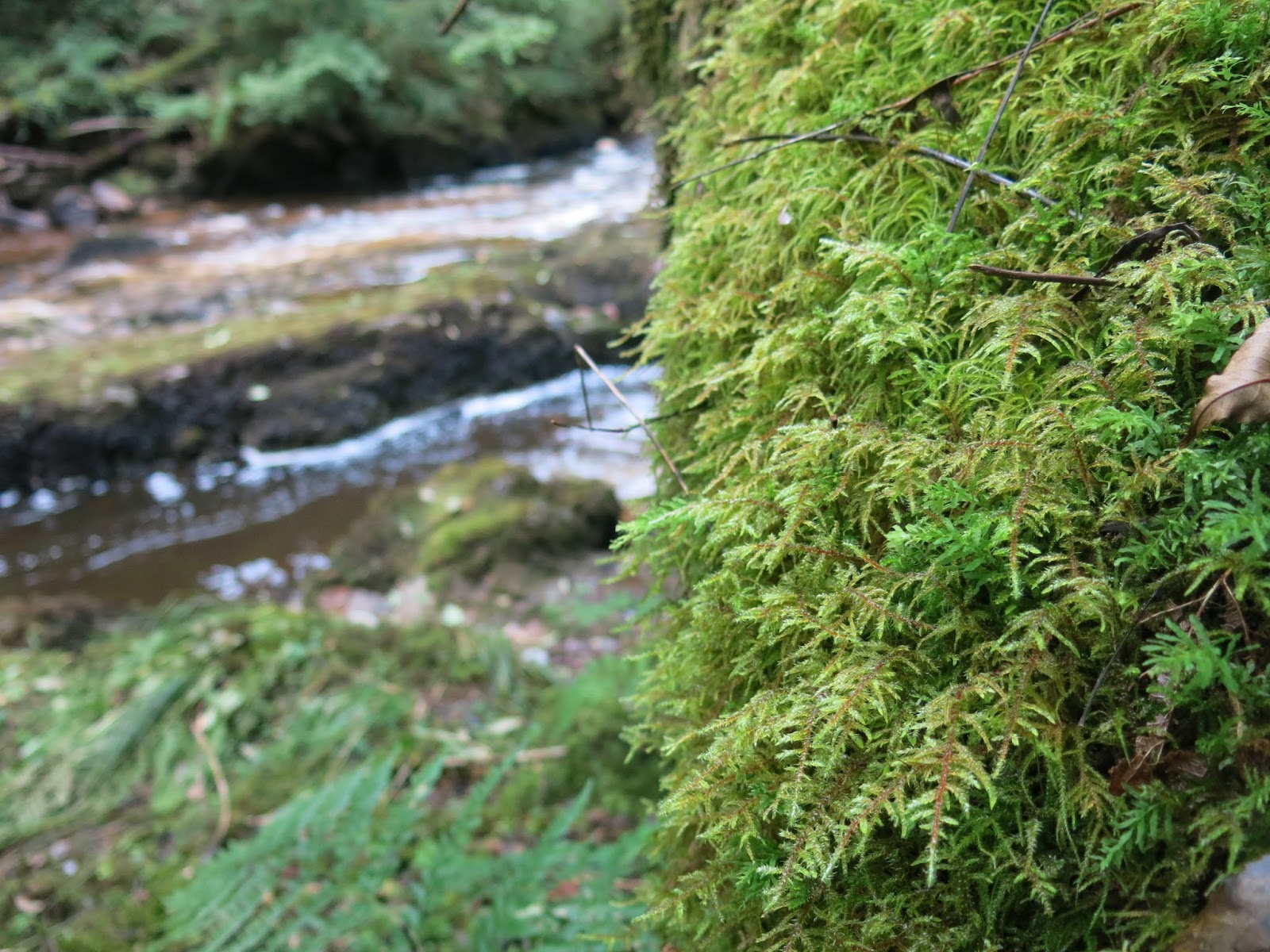
Rhytidiadelphus subpinnatus - 2 colonies seen: 1 on a boundary bank near Glan-yr-afon looked rather scrappy and intermediate, but this 1x1m patch on an Ash bole just above the river was absolutely classic!

Hymenophyllum tunbrigense - an honorary bryophyte that occurs in remarkable abundance in this part of the Nedd valley.  I took GPS readings for at least 20 different patches, most of which were >1x1m in extent.  Plagiochila spinulosa was alongside most of them.

A mystery liverwort - this is probably Kurzia trichoclados on humus on a Hymenophyllum crag, but it was very glistening and looks 'wrong'.  It is possible that this could be Telaranea europaea... annoyingly my compound microscope has bust, so I can't be sure.  If it is 'just' the Kurzia then it is new for Breconshire and the SAC, but if my dreams came through it would be the 3rd British record of the Telaranea!

There are still several completely unknown sections of the SAC and I have no doubt that more rare bryophytes await discovery.  Graham and I will be writing a report covering the bryophyte interest of the SAC this winter, which will help identify the gaps and should prompt a couple more expeditions.

Friday, 25 March 2016

Henrhyd Falls and Penwyllt

A Good Friday expedition with Bea and Johnny included a walk behind Henrhyd Falls (which Bea had visited once, but which totally amazed Johnny), fossil hunting in the limestone of the Penwyllt quarries, and then a cwtch between Bea and some horses on the WTSWW Allt Rhongyr reserve.  My first Swallows of the spring flew past near Seven Sisters.

There were a few brief bryological distractions:


Rhytidiadelphus subpinnatus by the path down to Henrhyd Falls - first found here by Graham

An intriguingly appressed Plagiochila-like liverwort on the rockface behind the waterfall;
I hoped it might be Pedinophyllum interruptum but the leaf insertion was wrong.  However...
 
 
The leaf axils of the Plagiochila held a spherical translucent fungus, which isn't Epibryon plagiochilae -very odd!

Isothecium-like Eurhynchiastrum striatulum on wooded limestone pavement at Allt Rhongyr
Tortula subulata (poor pic, sorry) at Allt Rhongyr;
there was also some Anomobryum concinnatum and Reboulia here
We bumped into Graham, Jackie and Connor on their way to Gower; I wonder whether Graham turned his eyes away from burial chambers and towards any bryophytes...

Friday, 4 March 2016

Mellte Valley

A few photos from today's superb outing to the Mellte Valley.


Examining the best horizontal trunk of the day
 and the banks of the Afon Mellte.
Distichium capillaceum
 Rhytidiadelphus subpinnatus
and finally my new favourite liverwort, Jamesoniella autumnalis (with a little Blepharostoma trichophyllum for good measure)

Monday, 18 January 2016

Penyclawdd Wood revisited

Penyclawdd Wood (SO40J/P) is part of my Dingestow Court home patch, and was one of the first areas where I recorded bryophytes 17 years ago.  Since then I have made many visits, but these largely stopped when Bea was born (7 years ago) and I have only looked once since 75% of the wood's conifer blocks were clearfelled in 2012.  That visit, in 2013, produced Dingestow's only Sphagnum record: a single patch of S. subnitens.  Yesterday I checked two other blocks of clearfell, one of which has been almost overwhelmed by Ulex gallii (!!) whereas the other remains relatively clear.  There was no Sphagnum, but species of note in the clearfell/regrowth areas included Archidium alternifolium (photo), Fissidens exilis (photo) and Fossombronia pusilla


A damp, clay track that was once heavily disturbed by farm traffic is now kept open by pedestrians (and deer) because vehicles use the tracks that were put in for conifer extraction.  The sedge-rich vegetation on the clay track holds locally abundant Campylium protensum (photo), scattered Bryum pseudotriquetrum (photo) and some non-fertile Weissia with decumbent shoots that is probably W. squarrosa (photo).


There were various blocks of broadleaved woodland among the conifers, and these now stand proud of the clearfell.  One area of 30 year old birches surround a spring where Chiloscyphus pallescens and Fissidens adianthoides grow alongside Valeriana dioica and various other calcicoles.  The floor of this 'birch grove' holds abundant Rhytidiadelphus triquetrus (very rare around Dingestow) and is the only site locally for R. loreus (photo) (a few shoots 15 years ago, but now a couple of small patches) and Loeskeobryum brevirostre (photo) (one hand-sized patch about 7 years ago, but now abundant over >5x5m!).


It is fascinating to be able to revisit this very diverse area of woodland after so long.  It used to support White Admirals, Glow-worms and many different moth species.  More to revisit over the next several years.

Friday, 6 February 2015

Don't always believe what the books say

Just flicking through the New Atlas and glanced at some of the comments regarding production of sporophytes in some species.   As recorders don't always make a note of whether a species was fruiting or not, it seems the BRC bryophyte database has very few records of fruiting in some very common species, which can then be interpreted as some species producing fruits only rarely.   Many of the common dioicous pleurocarps such as Calliergonella cuspidata, Rhytidiadelphus squarrosus, R. triquetrus, Hylocomium splendens, Pseudoscleropodium purum and the like are often reported in the text books as fruiting only rarely.  This may be true taking Britain as a whole, but we have found in south Wales that some of these species seem to fruit reasonably often.  I usually make a special search for fruits if I come across large patches of pleurocarps and it is surprising how often they are present - late winter seems to be a good time to look.   The next time you are walking across a dull bit of heathland with abundant Pleurozium keep an eye open for fruits - although this moss does seem fruit less often than some of the other species mentioned above.    You may have to dig around a bit in patches of some species - e.g. in Breutelia setae are very short and fruits hidden well inside hummocks; on Pseudocleropodium fruits appear to be produced on the previous years growth and so despite having a long seta the capsules can still be hidden amongst stems.

I have still to find fruits on Climacium in Wales (seen them once in Yorkshire) and the only time I have seen them on Rhodobryum was when I examined an old herbarium packet containing a specimen collected near Carmarthen, but I live in hope.


Friday, 21 November 2014

Rhytidiadelphus triquetrus further afield


The distribution of Rhytidiadelphus triquetrus in Glamorgan is partly elucidated by examination of maps from three other pretty well-recorded S Wales VCs. 
It has a very inland distribution in Pembs, largely avoiding the coast (except for a handful of very sheltered lane banks or churchyards, perhaps introduced with wreaths in the latter).
Colonies are widespread in Carms except around Llanelli and Carmarthen.  The strongest populations are on lane banks in the northern half of the county from Clunderwen to Llandovery.
Finally in Monmouthshire it is scarce except in the Black Mountains, with a few lane bank colonies around the Trellech plateau.

The first Atlas said that pollution had caused declines in Rhytidiadelphus triquetrus, and that would seem to make a lot of sense judging by its distribution in south Wales.  Roll on the time we can publish a S Wales tetrad Flora to really display these patterns!!

Rhytidiadelphus triquetrus

I was out in southern Ceredigion yesterday (Capel Dewi, just north of the Teifi) doing Brown Hairstreak egg surveys, and was struck, as always when doing BH surveys in SW Wales, by the abundance of R. triquetrus on lane banks.

I've still to record this species in Glam! Barry, could you post a map please? Maybe one for each of the Rhytidiadelphus species if you have time. Thanks.