Showing posts with label Plagiomnium. Show all posts

Monday, 29 October 2018

Rigid Bog-moss on Fairwood Common


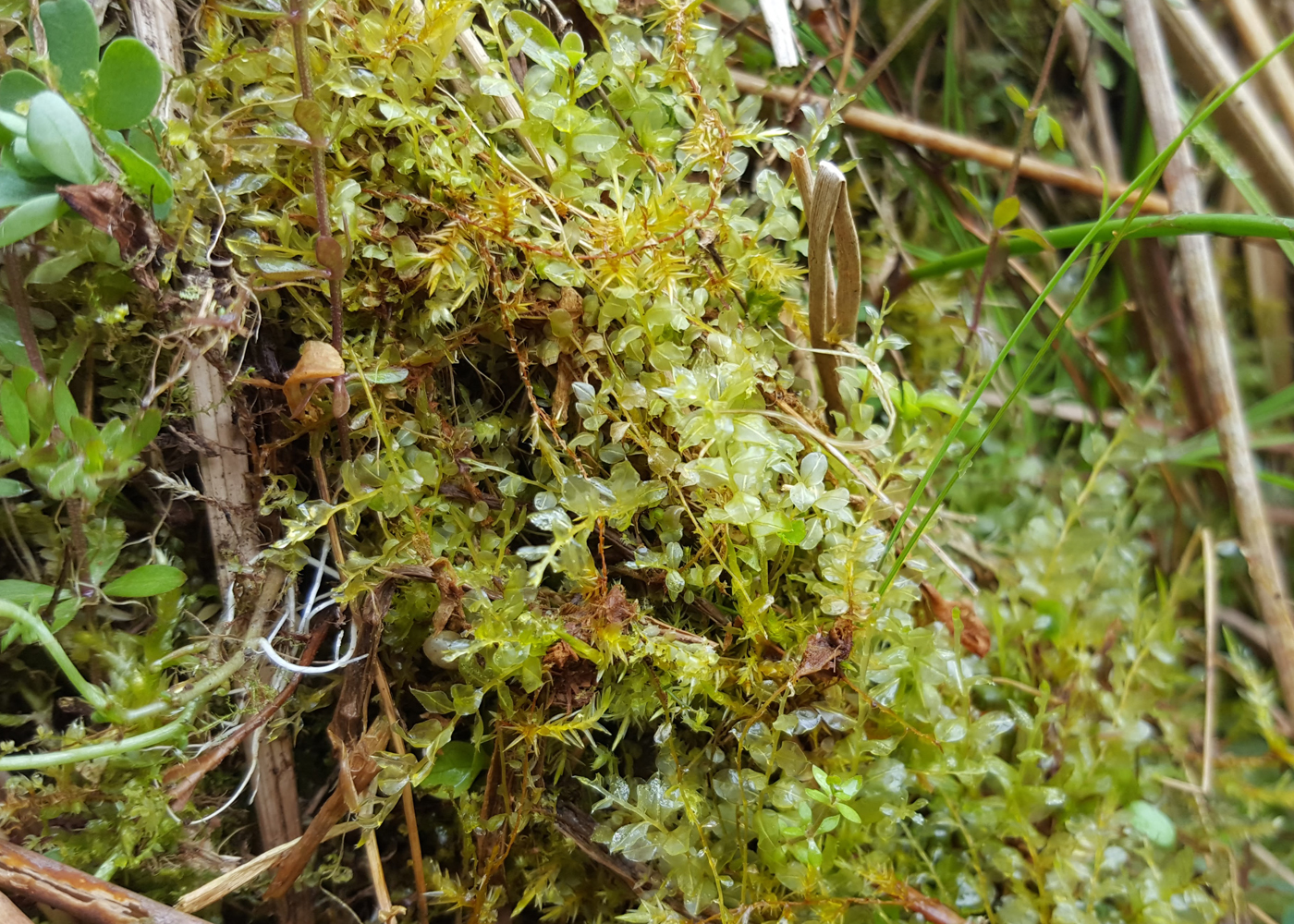
An M5-M21b mosaic on Fairwood Common held some good patches of Sphagnum teres (above & first below), which were frequent throughout a 1500sqm area. Carex rostrata was a constant in the areas where S. teres was prominent, the other main species of Sphagnum present being palustre (lots amongst marginal scrub - bottom photo), subnitens and papillosum. Plagiomnium ellipticum (photo below) was also found in the same area growing in quite luxuriant wefts along with P. undulatum and between mini-mounds of Campylium stellatum.  A little Cirriphyllum piliferum was unexpected and both ‘normal’ and ‘giant’ forms of Aneura pinguis were present. Some nice quality vascular plants were also present including Comarum palustre, Genista anglica, Menyanthes trifoliata, Narthecium ossifragum, Succisa pratensis and Vaccinium oxycoccos, though only the latter two species in good quantity.


Friday, 5 May 2017

Miscellaneous

While on a trip to Banwen and Onllwyn a few days ago, principally to check out some old meadows in the vicinity of the washery, H and I took a brief stroll along the path that bisects Gors Llwyn SSSI. Sam and others have recorded some nice wetland bryophytes here, including Hamatocaulis vernicosus, Kurzia pauciflora and Nardia geoscyphus. A good part of the SSSI is in Glamorgan (in NPT in fact), so it adds some significant species to the county list, and once upon a time there was a population of Trollius europaeus here. Carex elata, in one of its few inland sites in Glamorgan, is within easy reach of the path, just inside the county boundary, as is a nice photogenic colony of  Plagiomnium elatum along with Straminergon stramineum.

Plagiomnium elatum, Gors Llwyn

Straminergon stramineum, Gors Llwyn

The old meadows near the washery are of significant interest. One holds small populations of Epipactis palustris and Samolus valerandi, both increasingly rare in wetlands away from the coast in South Wales. Next door (and opposite Gors Llwyn) there is a superb swampy habitat with huge amounts of Bogbean, Marsh Cinquefoil and Water Horsetail and other M27 species. 
Yesterday, after reading George's account of Sam's Kenfig course, followed by a quick phone call to Barry, we went on an Amblyodon and Moerckia twitch. We spent most of the afternoon on our hands and knees with reading glasses on, occasionally loosing the will to live while searching for Moerckia! But success...thanks boys.

Amblyodon dealbatus, Kenfig

Moerckia flotoviana, Kenfig

Friday, 28 April 2017

Ammanford miscellany in SN61B

A population of Riccia subbifurca along a muddy track near Ammanford was unexpected. There were few other species of note other than Plagiomnium elatum, which was recorded nearby in marshy grassland in association with abundant Valeriana dioica. A pink Bryum, possibly pallens (still to check my specimen), was collected from an area of disturbed wet grassland, Physcomitrium pyriforme being the most frequent associate.

Thursday, 9 February 2017

Fairwood airport

I made a brief stop-off on Tuesday to look at the section of concrete runway outside the perimeter fence SS573910 at Fairwood. This revealed small quantities of Plagiomnium cuspidatum (photos above) growing with more abundant associates that included Brachythecium albicans, Ceratodon purpureus, Climacium dendroides (photo 7), Didymodon insulanus, Hypnum cupressiforme var. lacunosum, Syntrichia ruralis var. ruraliformis and some attractive tufts of Bryum dichotomum var. barnesii (photos 5 & 6). Campylium protensum and Ctenidium molluscum were frequent along the adjacent track.

Thursday, 29 September 2016

Ty-du Moors SSSI

I spent a fascinating and enjoyable day on this Cardiff fen with Julian Woodman, trying to work out why base-rich areas (with Eriophorum latifolium, Epipactis palustris, Gymnadenia sp. and Triglochin palustris) are becoming increasingly dominated by Sphagnum subnitens and Aulacomnium palustre.  We concluded that more work is needed, with input from Gareth Farr (what a shame you couldn't join us today, Gareth), but probing revealed over 2.5m of peat near the centre of the moor, whilst test coring showed that the base-rich areas and associated Juncus subnodulosus fen are on continuous peat, whereas the edges of the moor with Carex acutiformis fen has a layer of organic-rich clay-silt above the peat.


Campylium protensum is locally abundant in the remaining good, base-rich areas, along with Fissidens adianthoides, Plagiomnium ellipticum, P. undulatum and one stand of Dicranum bonjeaniiChiloscyphus pallescens and Cratoneuron filicinum were only in one area.  Poached damp grassland held Pseudephemerum nitidum and one patch of Ephemerum serratum


A check of surrounding Willow scrub was worthwhile, with a fruiting patch of Pylaisia polyantha on one Willow, as well as commoner epiphytes.  I think this is the 2nd Glamorgan record, following one on south Gower.  It's a pity that I found this epiphyte after George had left us, following his visit in the morning.  Nearby Alder carr held a peculiar tiny, narrow-leaved moss with gemmae on the leaf tips, forming an extensive patch on a well-rotted log.  I'm 99% certain this is Plagiothecium latebricola. {sorry about the bad iPod photos, I wish I knew how to rotate them in Blogger}.
 

Julian and I ended the day with a visit to some wonderful damp arable fields that Nick, the owner of Ty-du Moors, manages.  We relocated the Anthoceros that Julian and George saw last autumn, and I have a specimen to measure (though it's 99% certain to be A. agrestis).  Alongside were several thalli of Phaeoceros sp. (probably P. carolinianus but needing more study), and abundant Riccia glauca and Fossombronia sp.

All in all a good day, and I hope a boost for tetrad ST17E.

Wednesday, 13 April 2016

Sausages and Thyme

Jamie Bevan spotted some String-of-sausage lichen (Usnea articulata) in the Jersey Marine Alder-Willow Carr this morning, near the Tennant Canal tow path. It's a great record for NPT, although all the indications suggest that this rare, pollution sensitive species is now expanding its range in south west Britain. It was a good excuse for a leisurely afternoon stroll.

Usnea articulata, Jersey Marine (SS71109382)

The Alder-Willow Carr here also has a very significant population of Plagiomnium elatum (Tall Thyme-moss), which for some reason had not been recorded in the MM data base. This rather attractive moss is locally abundant on the wet woodland floor near the tow path and it is looking particularly fine at the moment. It appears to be rather scarce in Glamorgan overall, but there is a robust population in Jersey Marine.

Plagiomnium elatum, Jersey Marine

Plagiomnium elatum, Jersey Marine

Oxyrhynchium speciosum is also quite common in the wood and there is a small amount of Colura

Tuesday, 6 January 2015

Penclawdd copperworks revisit 1

Plagiomnium cuspidatum with a few scraps of Lophozia excisa
I nipped down to Penclawdd to take Alfie for his constitutional walk today and spent 40 minutes on part of the ridge mentioned below. I was very pleased to relocate Sam's Plagiomnium cuspidatum, although P. affine/undulatum? [see below] was more frequent and I also found a few scraps of Lophozia excisa. In the process of producing a more complete list for the site I was struck by the Bryum below, which looks very kunzei-like to me. Whilst calcifuge species were more prominent, there were scattered patches of calcicoles; associates in the immediate vicinity of the Bryum included P. affine, B. capillare, Hypnum cupressiforme var. lacunosum, H. jutlandicum, Ceratodon purpureus & Barbula convoluta. Under the microscope the leaf margins are very weakly bordered with a few tiny, but sharply pointed teeth distally. the margins are weakly recurved towards the leaf base which is pigmented red. The single unripe sporophyte may be a bit of a negative as I'm not sure if fruiting is known in Britain? As always any comments are welcome.
Bryum caespiticium and spot the Lophozia excisa!
Re: Plagiomniun aff/und - I often get muddled by these two as stunted undulatum looks very similar to affine to me - what is the best way to separate them in the field?