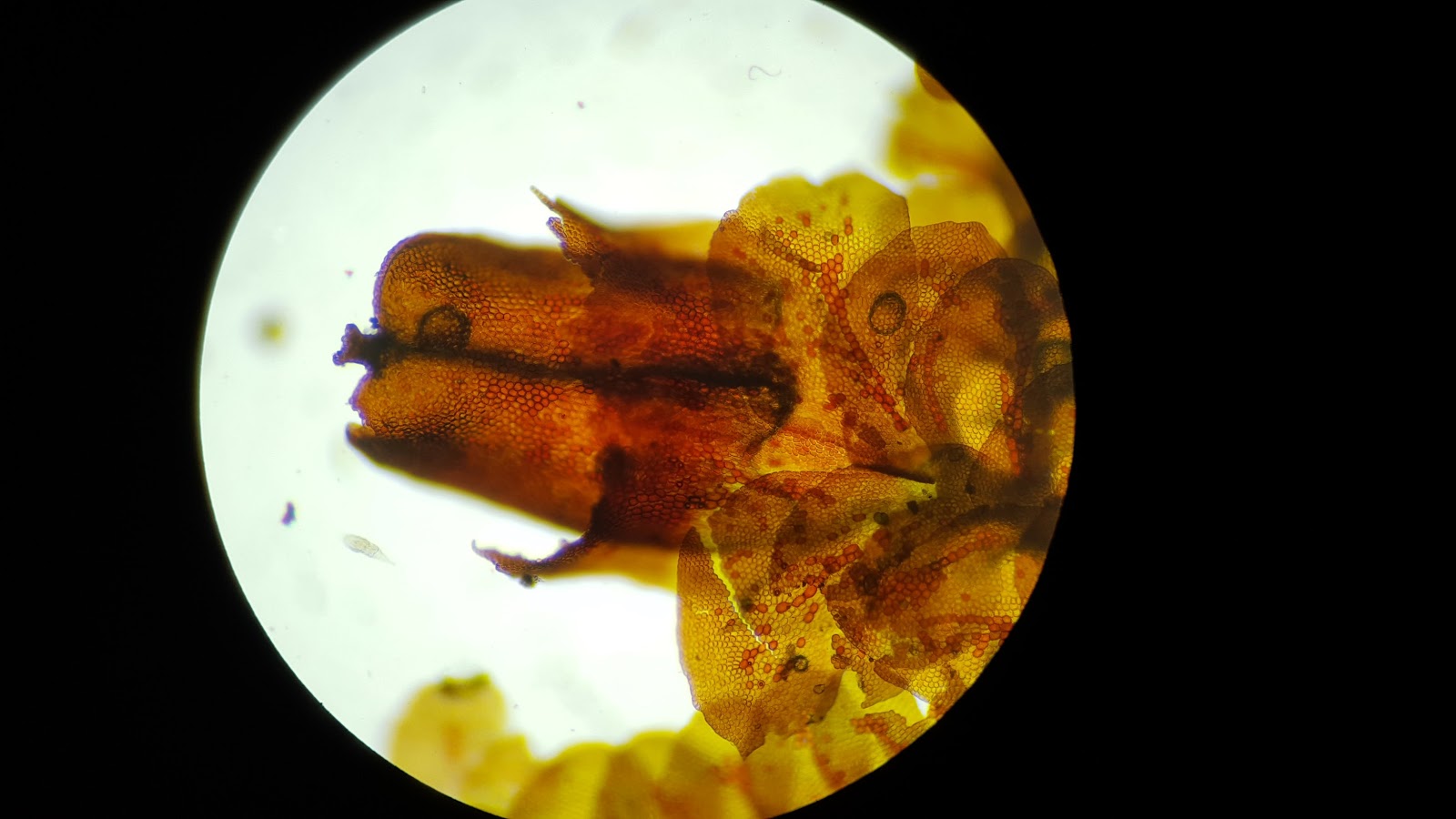
Showing posts with label Frullania. Show all posts

Thursday, 9 November 2017

Damp bryo birthday bash

I took the day off work on Tuesday with the intention of a birthday bryo outing to the hills, but the morning rain put me off attempting anything at altitude. So it turned into a woodland day instead - less extreme but thoroughly enjoyable.

I started with a trip to see the Lepidozia cupressina colony at Caerphilly Mountain (found by Peter Sturgess in 2015). It was much easier to find than on our frosty visit in January 2016, though I only found patches of it on three stones (Bazzania trilobata was much more extensive).
 
After that I nipped up to Nant Gelliwion Woodland SSSI on the edge of Pontypridd, where we only scratched the surface during a fungus group foray in September. The site held records of 18 common bryo species, mostly from past CCW surveys, but had clearly never been properly explored.
I spent a couple of hours exploring the stream and the north-facing slope of the woodland, which produced a few species of local significance including two which I think are new for ST08. The best of these was Metzgeria conjugata, which occupied the downstream side of a stream boulder (outlined in photo below). Also of note was Heterocladium heteropterum var flaccidum.
A few other often sterile species were seen with capsules, including Tetraphis pellucida, Homalia trichomanoides and a large, dark green form of Ctenidium molluscum (photos below).
 
Many of the decorticated logs in the wood were covered in Nowellia and one had a couple of patches of Riccardia palmata. A more recently fallen tree held some Frullania tamarisci.
I also have some hair-pointless Racomitrium on which to attempt a nerve section - given the streamside location I'm hoping this might be R. affine.
70 taxa were recorded within the wood; another visit to explore the other side of the valley would surely add more. Additional exploration along the lanes and in the conifer plantation elsewhere in ST08P would probably take this tetrad to a very respectable species total.

Tuesday, 7 February 2017

Hillend ORS

Today I finally checked a few specimens I brought back from a 1 hour visit to Hillend, at the northern end of Rhossili Down,on the 4th (the area searched shown above). There is a nice rocky ridge in this area, marking the geological boundary of the Brownstones formation and the Upper ORS. The Frullania on the rocks looked interesting and one of my samples had a mix of tamarisci, dilatata and microphylla var. microphylla, the latter new for the county. I'm pretty confident this is correct and whilst a barely detectable fragrance put a little doubt in my mind, everything else seems spot on. The flat leaves seem to be a good field feature. Occasional burgundy patches of Frullania were dotted around the rocks and whilst I'm not 100% sure which rock my sample came from, I suspect it was that shown in the above photo (approximately SS41939097). I'm sure further searches will reveal further patches with microphylla mixed in. Other species noted included some nice patches of Grimmia trichophylla, Pterogonium gracile and Scleropodium touretii.
G. trichophylla
coastal lichens were much more prominent than bryos.
rocks with Pterogonium, Isothecium myosuroides and Hypnum cupressiforme var. resupinatum

Thursday, 19 May 2016

Odd Orthotrichum

The above tuft was noted in a young Ash plantation near Pont-Henri, where many of the trees looked to be in very poor health. Essentially it is O. pulchellum but with capsules on very short setae, resulting in them being hidden among the shoots. I couldn't make it anything rarer unfortunately, but would be interested to know if this appearance is unusual?
The trees may be sickly, but the extra light seems to have allowed the bryophytes to do well ...
... with abundant Frullania dilatata, 3 Metzgeria spp. & Radula complanata  

Wednesday, 13 April 2016

Stanner shines in rainy Radnorshire

Grimmia decipiens under scrutiny
On Monday Sam led a BBS group around Stanner Rocks showing us a succession of rare Grimmia species and much more besides. Whilst the weather was not ideal for looking at the critical characters of this tricky genus, the liverworts were at their best and together with vascular plants, highlights came thick and fast and included Bartramia stricta, Frullania fragilifolia, Gagea bohemica, Grimmia decipiens, G. laevigata, G. lisae, G. longirostris (poss?), G. ovalis, Riccia beyrichiana, R. nigrella, R. subbifurca, Schistidium pruinosum, Sedum forsterianum, Silene viscaria, Targionia hypophylla, Teesdalia nudicaulis & Veronica spicata. Phew!
Above:
G. decipiens - G. lisae
G. longirostris - G. ovalis
Schistidium pruinosum

Below:
Bartramia stricta - Frullania fragilifolia
R. nigrella - Silene viscaria
Sedum forsterianum

a rather nice little community with Bartramia stricta, Sedum forsterianum, Silene viscaria, Targionia hypophylla, & Veronica spicata.
rain-soaked Rory taking an end of session record shot of rain-soaked Stanner

Thursday, 23 April 2015

Commonest bryophyte species

Julita Klusa has just put a link to her list of Latvia's top 20 commonest bryophytes on Twitter.  It is fascinatingly different to the top 20 in south Wales!

Rank Pembrokeshire (SW Wales) Latvia UK notes
1 Kindbergia praelonga Hypnum cupressiforme Abundant (No. 2 in Pembrokeshire)
2 Hypnum cupressiforme Leucodon sciuroides Uncommon and very local
3 Brachythecium rutabulum Hylocomium splendens Locally abundant but habitat specific
4 Frullania dilatata Plagiomnium undulatum Locally abundant but habitat specific
5 Metzgeria furcata Pleurozium schreberi Locally abundant but habitat specific
6 Lophocolea bidentata Rhytidiadelphus triquetrus Locally abundant but habitat specific
7 Isothecium myosuroides Dicranum scoparium Locally abundant but habitat specific
8 Bryum dichotomum Climacium dendroides Uncommon and local
9 Mnium hornum Orthotrichum speciosum Rare and eastern, not in Wales
10 Tortula muralis Radula complanata Increasing and locally abundant
11 Bryum capillare Atrichum undulatum Abundant (No. 12 in Pembrokeshire)
12 Atrichum undulatum Nowellia curvifolia Locally abundant but habitat specific
13 Ulota phyllantha Rhytidiadelphus squarrosus Locally abundant but habitat specific
14 Dicranella heteromalla Eurhynchium angustirete Not British
15 Bryum argenteum Homalia trichomanoides Locally abundant but habitat specific
16 Calliergonella cuspidata Ptilium crista-castrensis Uncommon and north-eastern
17 Fissidens bryoides Plagiochila asplenioides Locally abundant but habitat specific
18 Thuidium tamariscinum Syntrichia ruralis Locally abundant but habitat specific
19 Didymodon insulanus Neckera pennata Extinct in Britain, one historic record
20 Ulota bruchii Plagiomnium cuspidatum Uncommon and very local

This has got me thinking again what a pity it is that the South Wales Bryophyte Blog is only visible to 'members' and I wonder whether we could make it more visible but with commenting and blogging limited to 'members'.