Showing posts with label bicrenata. Show all posts

Thursday, 3 January 2019

Miscellaneous December mosses (and liverworts!)

Here are a few images of some interesting observations I've not found time to post about over the last few weeks of 2018:

A rubbishy record shot of Campylopus subulatus collected from a forest track at Gwaun Nant-y-bwch during an excursion with Charles on 11th Dec. This is just the third Glamorgan site.

Lopidium concinnum (Hypopterygiaceae) was the most conspicuous of four aliens noted on a Dicksonia antarctica 'trunk' in Swansea's Wyevale on 20th December. Heteroscyphus fissistipus was the only other species I managed to identify. All were recorded as live, although the exposed parts of the Lopidium shoots were dead/bleached.

On the same day I was at Wyevale, I did a quick check of the Kilvey Hill Cephaloziella calyculata colony, but failed to find anything resembling integerrima, the only only other Cephaloziella noted being divaricata. The colony was highly fertile, with male plants (photo) and gemmiferous shoots abundant (photo). Perianth development was, however, uniformly at a very rudimentary stage and well behind those of integerrima seen recently at Crofty. There are still plenty opportunities for exploring unsurveyed areas at this site - i.e. most of it!

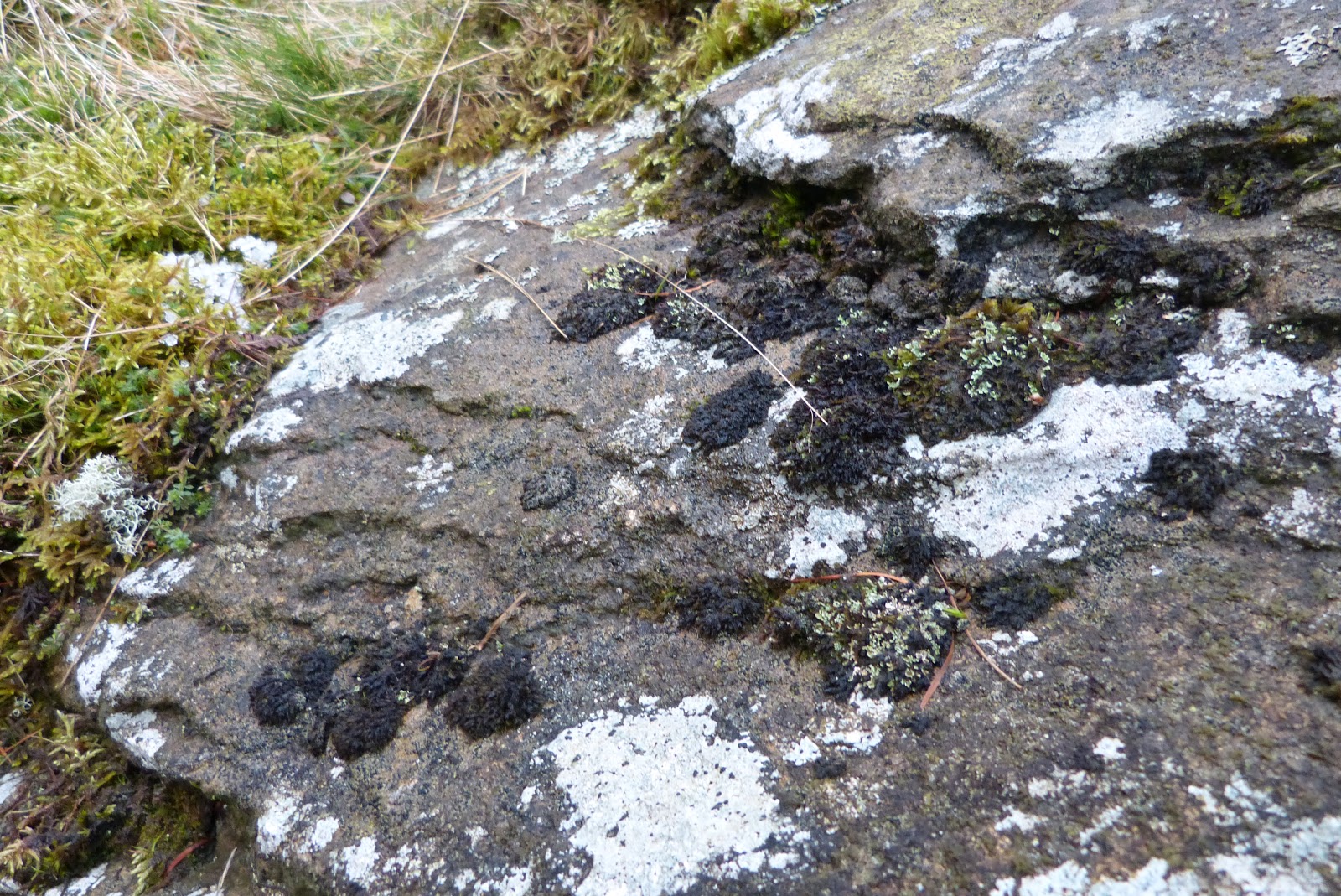
The distinctively scented Lophozia bicrenata was found growing with Vezdaea retigera on mine spoil on Cadle Heath Common in Swansea on 21st Dec.

Lophozia ventricosa var. silvicola is occasional on Sphagnum papillosum on Cefn Bryn, 31st Dec. As reported by Sam in the Pembs Bryoflora, it seems this defunct, yet distinctive taxon is the default var. on Sphagnum in our area.

A good quantity of Marchantia polymorpha cf subsp. montivagans "Mountain Liverwort" was encountered mostly 'in stream' in a base-enriched runnel on Cefn Bryn, also on 31st Dec. The large thalli clearly lacked black midribs that characterise subsp. polymorpha, though were darkened a little, as shown by the example below, photographed in natural day light (it was almost dark by the time I got to this spot and to make things worst as I was walking back up the hill I realised I must have dropped my phone in the runnel - fortunately I did manage to find it before the light completely went, sitting amongst Montia in-stream, half soaked, but still working!). I failed to get to grips with the ventral scales of the Marchantia, but I will take another look before sending off a voucher for verification of this potential county first.

Tuesday, 13 March 2018

Out and about

I've had a lean winter recording-wise, but at least February proved to be reasonably productive. Most records were made around Cardiff, Bridgend and Merthyr Tydfil, during stop offs on the way home from work trips. Nothing remarkable has been recorded but minor highlights have included:

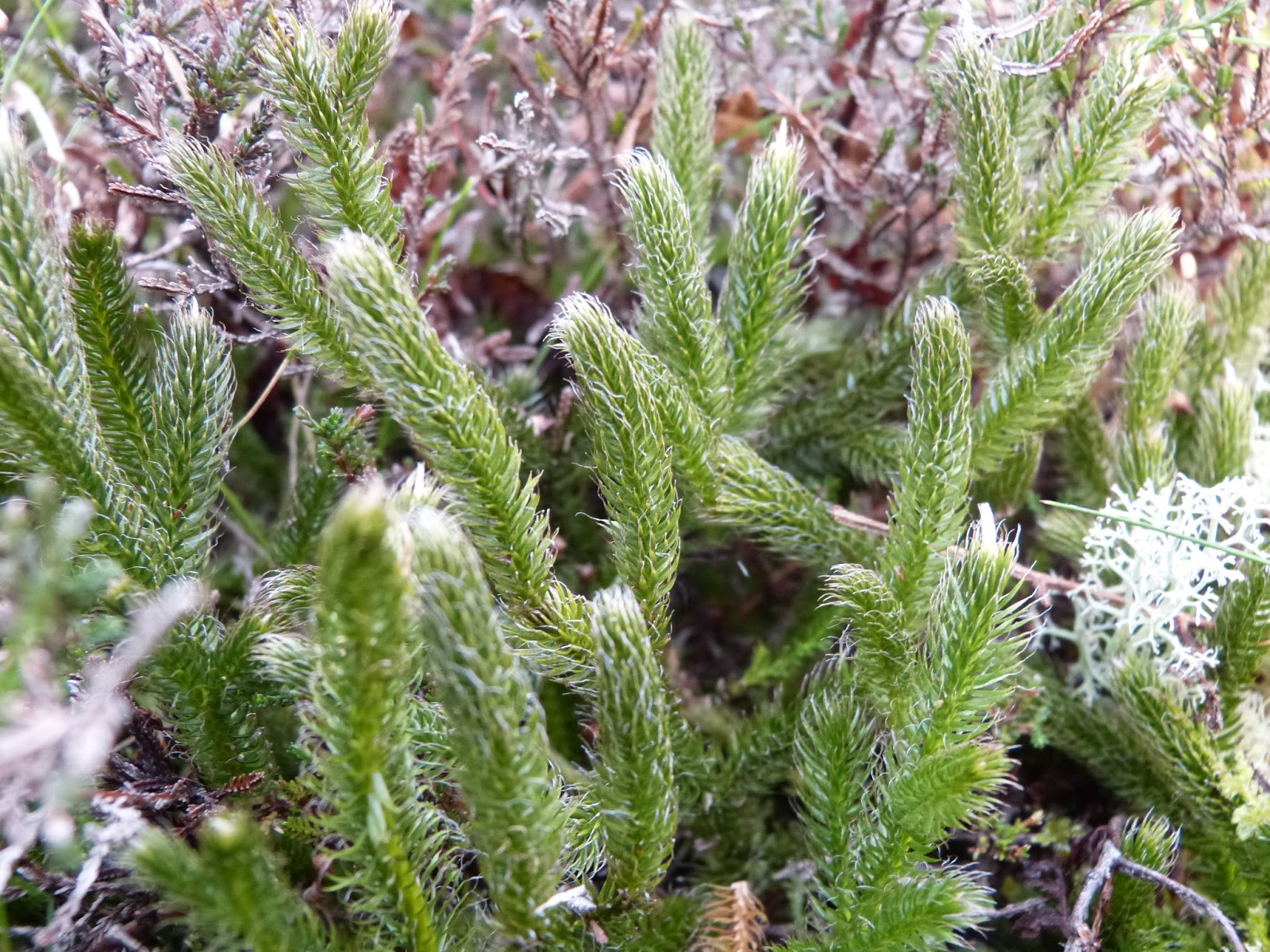
Lophozia bicrenata growing with Lycopodium clavatum among sparse Calluna heath on the former dry ski slope at Troedyrhiw (SO0703). I first saw the clubmoss here back in 2007 and it was pleasing to see it still thrives at the site.
 

Bryum violaceum on gravelly roadside soil, also at Troedyrhiw (SO0603); note smooth violet rhizoids and small tubers.


Scapania compacta and Andreaea rothii ssp. falcata on sandstone quarry waste at Merthyr Vale (ST0899).


In Cardiff and Bridgend I've not seen anything noteworthy, though it has been good to confirm Ulota crispa s.s. from several localities (I've been unable to find either U. intermedia or U. crispula to date, despite microscope checking of quite a few samples).

I'll aim to prepare an updated tetrad map in the next couple of weeks, which should show at least a few recording gaps being filled.

Friday, 3 March 2017

Grimmia orbicularis

Today's photograph of my samples from Coedffaldau, which clearly show the differences between Grimmia orbicularis and G. pulvinata. Below, from the same day, Lophozia bicrenata growing in an extensive mat of hepatics at Bryn-melyn sandstone quarry (SN73781134), the main associates being Solenostoma gracillimum, Diplophyllum albicans and Nardia scalaris. The distinctive leather / cedar-wood smell of my sample is remarkably strong for such a small plant, even when dry. This character, when coupled with the compact shoots with golden-brown gemmae, make field identification straight forward.

Friday, 10 February 2017

Cwar Du - a boost to SN90F

I spent my lunch hour (well actually a split 20 minutes before and after my main work) recording in SN90F, east of the A4061 between Treherbert and Craig y Llyn.  This was slightly pointless because there were already over 70 species recorded from the tetrad, but it looked like good ground as I drove past and I thought I'd add something.  In the end I found about 95 species, and there were 14 on the previous list that I didn't see (mostly plantation & track species), so the tetrad is now nicely over the 100 mark and can probably be regarded as 'done'.


First stop was a small, sealed-up, graffiti-covered building surrounded by sculptures, where I recorded various ruderals including Tortella tortuosa, Orthotrichum cupulatum and Schistidium apocarpum on concrete.  A yomp up through scree with 4 cushions of Scapania gracilis led to the Cwar Du cliff base at 450m altitude, where Ditrichum zonatum new for Glamorgan awaited me.  Nearby were Campylopus atrovirens, a small form of Gymnocolea inflata, some Lophozia sudetica, and a bit of Rhabdoweisia crispata.  A rowan added Cololejeunea minutissima and other common epiphytes to the list.


After I'd finished my work near Glyncorrwg I stopped briefly at Nant y Bwlch, just down from Cwar Du, to add some stream mosses to the list.  Hygrohypnum ochraceum and Hyocomium armoricum were present in the stream, Ptychomitrium polyphyllum was on boulders, Polytrichum alpinum was on a low cliff, and slight base enrichment was indicated by a few shoots of Trichostomum brachydontium among Amphidium mougeotii.  Perhaps the highlight of this area was some Lophozia bicrenata with perianths on humus under heather - a thoroughly unpredictable species.


So, a worthwhile stop given that I didn't have time to properly bash an unknown tetrad.

Sunday, 21 February 2016

Blustery and bleak on the Blorenge


I had two targets on the colliery spoil between the Blorenge and Blaenavon and failed on both: Lophocolea bispinosa doesn't seem to have reached the eastern Valleys yet, and Buxbaumia aphylla was always going to be a long-shot :-)  The wind and drizzle didn't help.

Anyway, I made separate DAFOR lists for a heather/crowberry-dominated colliery tip face (21 spp including Lophozia ventricosa silvicola and Cephaloziella hampeana), and a much more open, parched tip top (6 spp), and also found some Lophozia bicrenata on the side of a gully between two tips.


 A short trip north to Cwm Ifor, where a stream has carved a narrow ravine at the junction of the Millstone Grit and Carboniferous Limestone, produced a completely different flora.  Neckera crispa was amazingly abundant and was fruiting copiously, and there were various other calcicoles including Scapania aspera and Jungermannia atrovirens, although I couldn't see any sign of several of the notable species I found in the ravine in 2000/2003.  An outcrop of Millstone Grit above the ravine held abundant Barbilophozia attenuata and there were a few patches of Sphagnum squarrosum in a flush. 


My entire 1.5 hour visit was spent in tetrad SO21K, which is one of the richest in VC35 with >200 species recorded.  I visited many times between 1999 and 2003, including with Graham and with the Border Bryologists, so it was nice to return to old haunts.  Perhaps surprisingly, given previous coverage, I added 11 species to the tetrad total, so the day was useful.

Friday, 19 February 2016

Kilvey revisited

A 30 minute search on a barren-looking patch in the north-west corner of the hill SS66609490
produced my first record of Lophozia bicrenata (two lower images). After keying it out I gave it the sniff test and was amazed, despite the diminutive size of my sample, how strong the distinctive leathery smell was. Associates were Gymnocolea inflata (abundant, below: top pic), with occasional Pohlia annotina, Pogonatum aloides, Pohlia nutans, Cephaloziella hampeana, Calluna vulgaris, Festuca ovina and Diplophyllum albicans.

I've no idea what contaminant is inhibiting the growth of vascular plants in this area, but the bryophyte assemblage is very different from the metallophyte community at Pluck Lake, where Weissia controversa var. densifolia and Bryum pallescens grow in abundance.