Showing posts with label Dicranum. Show all posts

Tuesday, 18 February 2020

Moss on a pole


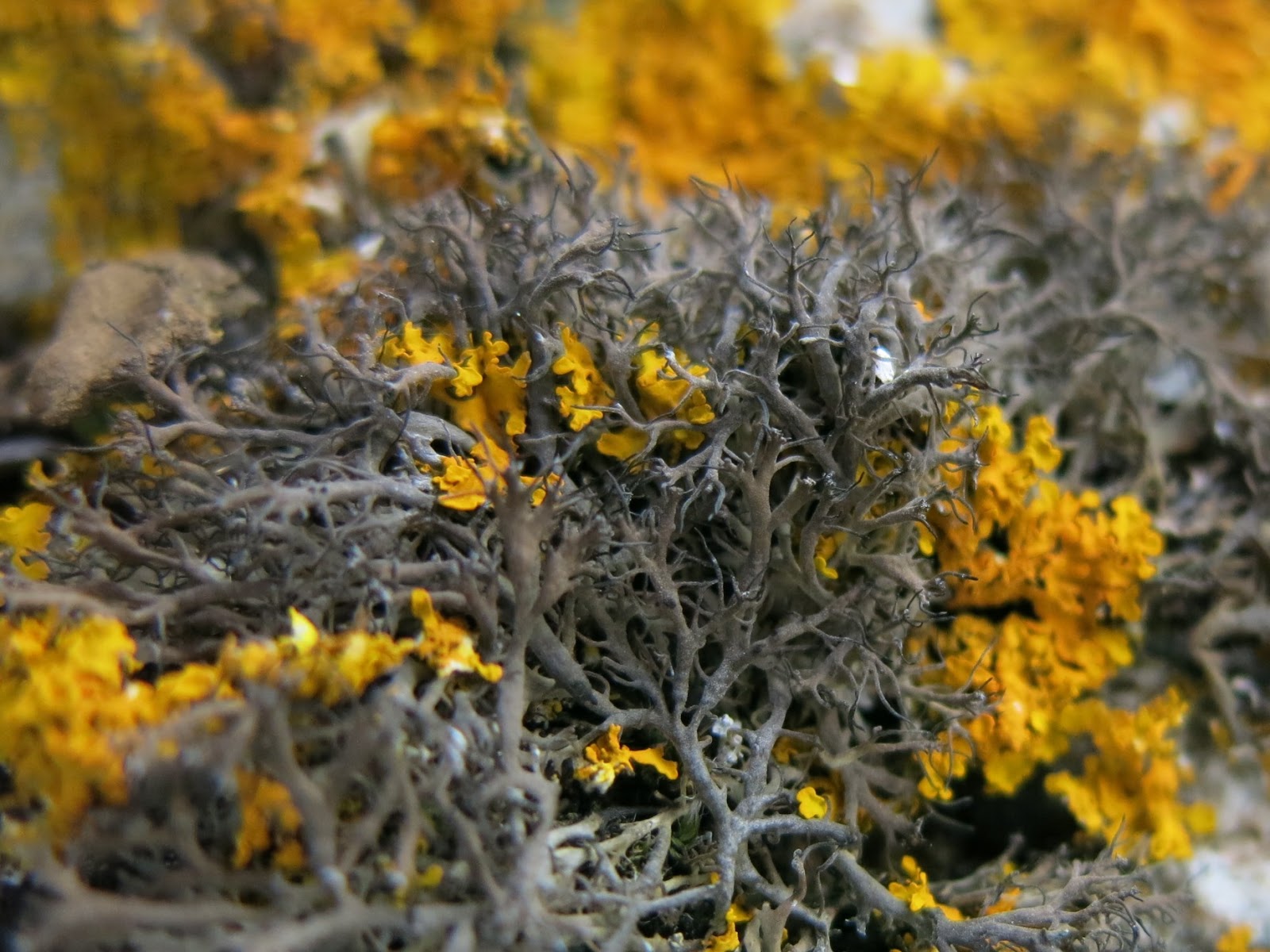
Well, on the stump of a pole.  Dicranum montanum was a long overdue 'lifer' for me and it was reassuringly distinct enough in the field (photo above) to immediately suspect it as being a good a candidate for montanum, though I only got round to checking my voucher last night.  It would appear to be genuinely scarce in Glamorgan, this being the first record since 2005, when it was recorded at Pencoedtre by an unnamed 'EcoTech' surveyor/subcontractor.  The only other 21st Cent. record was made by Sam in 2002 at Blackmill SSSI.  Given the unspectacularness of the habitat for this record (a weathered telegraph pole at a coal mine washery), there is possibility it occurs more widely.  The very sprawly-curly leaves of dry plants impart a distinctiveness quite different from the potentially confusing Dicranoweisia cirrata.

Monday, 19 February 2018

A Grave subject


Churchyards provide habitat for a number of bryophytes that are rare or absent from the typical farmed landscape of lowland Monmouthshire, including rock-dwellers like Racomitrium aciculare (which is quite frequent on flat sandstone gravestones), woodland species like Cirriphyllum piliferum and Rhytidiadelphus triquetrus, unimproved grassland mosses such as Pseudoscleropodium purum, and acidophiles including Dicranum scoparium.  The last of these can be abundant on graves surfaced with acid gravel, as was the case at Llanddewi Rhydderch where I took the photo above.

Tetrad recording in the Llanddewi Rhydderch square (SO30L) produced just over 50 rather mundane species.  Highlights away from the churchyard included a few epiphytes in a lane, with a single tuft of Orthotrichum anomalum (sadly with all but one of its capsules slugged, so I can't be 100% certain it wasn't O. consimile) being the most unusual record.  Anyway, this is another tetrad ticked off the list, leaving 101 which I haven't yet visited.


Wednesday, 31 January 2018

Mellte Valley Photo-trip

 I didn't have a good photograph of Solenostoma sphaerocarpum, so yesterday afternoon H and I went to see the nice little colony that Barry found in the Mellte Valley a few days ago.

 Solenostoma sphaerocarpa, Mellte Valley

 The winged perianth with a short beak, and the circular leaves, are distinctive.
Further up the valley we caught up with the Dicranum montanum that I remember from the Mellte trip led by Sam a few years ago. I didn't get a chance to photograph it then, so it was nice to get it again on a few trees near the trail.

Dicranum montanum, Mellte Valley

Some of you will also remember the remarkable riverside site nearby with both Tunbridge and Wilson's Filmy-fern growing within feet of each other.

Hymenophyllum tunbrigense, Mellte Valley

Hymenophyllum wilsonii, Mellte Valley

Saturday, 6 May 2017

A weekend on Lundy - mosses and liverworts

Clare and I spent the bank holiday weekend on the magical Lundy Island, sailing from Bideford after dropping Bea and Johnny with their grandparents in Sussex.  South Wales was visible from Lundy (when it wasn't raining), so perhaps it isn't stretching the Blog title too much to mention some of the bryophytes I bumped into during our visit.  Clare enjoys walking for walking's sake, whereas I walk to get to recording sites, but we had a good compromise where Clare strode between headlands and waited with a book whilst I made a few stops in between; we did plenty of walking together too.


On our first day included a walk up the west coast of the island as far as the Halfway Wall.  The path down to the Battery produced Anthoceros punctatus (photo) and Tritomaria exsectiformis (photo), whilst rocky heathland a little further north held Kurzia sylvatica.  A flushed area (photo) with Bryum alpinum also supported Fossombronia sp with violet rhizoids, which I suspect is F. maritima; I'm growing some on in a tube in the hope of sporophytes.  Pogonatum nanum (photo) was fruiting beautifully on a bank nearby.


Our second day was marred by heavy rain in the morning, but we ventured out a few times along the east side of the island.  Bryological highlight was Frullania teneriffae (new for VC4) alongside Scapania gracilis in the VC Quarry (photo).  Exploration of the wooded Millcombe valley produced Epipterygium tozeri, Pohlia lutescens and Plagiochila asplenioides, whilst Schistidium rivulare was a surprise on rocks in the Quarter Wall Pond.


Our third and final day involved a stomp along 'The High Street' to the north end of the island (4 km away from The Village) followed by a walk back along the east side.  Lepidozia cupressina (photo) and Dicranum scottianum (photo) grew together on a tor just south of Gannets Coombe - like Dartmoor in miniature - and there were Cephalozia connivens and C. lunulifolia nearby.  Salt-sprayed turf near the northern lighthouse held Hennediella heimii, and a Bryum nearby looked interesting but was unfortunately non-fertile.  Finally, an exploration of Landing Bay while we waited for the boat back to the mainland produced Schistidium maritimum and Weissia perssonii at last: most of the island is too steep to allow descent to the maritime areas favoured by these species.


I don't actually know how many of the 100+ species that I recorded (with 8-fig GPS readings) were new for the island.  The BBS dataset seems extremely incomplete, especially for liverworts, with some broad-date 20th century records and a list made by Mark Pool in 1997; I added nearly 30 species to the hectad tally according to the BBS data.  However, Jean Paton's data from her visit in 1975 does not appear in the BBS dataset and several of my 'additions' were already recorded by her (unsurprisingly!), and Jean spotted several liverwort during her "few hours" on the island that I missed.  The Lundy Field Society reports may include other liverworts, but the issues that I looked at didn't have anything.  Mosses seem to be even more under-recorded, and the only reference I can find is a list from 1959 with IDs by Michael Proctor, and it is that list which forms the basis of the BBS data.  I will, of course, make sure that my records go to the BBS and the Lundy Field Society.

As well as the bryophytes, we saw Lundy's famous Lundy Cabbage (none of the plants by the paths were in flower unfortunately), Balm-leaved Figwort, Primrose Peerless and Ophioglossum azoricum.  Star lichens were Teloschistes flavicans and Anaptychia ciliaris subsp mamillata.  Bird highlights were the Lundy rarities Yellowhammer and Stock Dove, which I found during our wanderings, and there were various Warblers around, Black Redstart, Pied Flycatcher, Whimbrel etc.  Lundy really is a fabulous place for a wildlife-rich holiday!


Friday, 27 January 2017

Homage in the Hepste

It's nearly 18 years since Graham and I visited Sgwd yr Eira to pay homage to the southernmost British population of Sphenolobopsis pearsonii - found by Martha Newton in 1994 and 'twitched' by us in 1999.  We were glad to see that this Nationally Scarce liverwort is still present on one rockface (we assume it's the same one where Martha found it, though we haven't yet checked), but were worried to see that most of the patch looks moribund.


On our way to the Sphenolobopsis we searched the ravine downstream - where Plagiochila bifaria was present in a classic mist-zone location - and some south-facing cliffs where putative Ctenidium molluscum var robustum (or perhaps var condensatum) grew close to var molluscum and looked convincingly different (if un-nameable).  Nearby there was some Dicranum montanum on a log.


Then we reached Sgwd yr Eira, with its classic walk-behind waterfall and extensive mist zone.  Most Ash trunks were plastered with algae - too humid for anything else perhaps - but eventually we found some Plagiochila exigua at the base of an Ash.  Unlike the small Lejeuneaceae this species lacks propagules, so it's a sure-fire indicator of long-term Atlantic bryophyte richness in the valley.

The first stretch upstream of Sgwd yr Eira was a bit dull, but frequent Anastrophyllum hellerianum on logs and a few patches of Filmy Ferns kept us going until we reached a set of low cascades.  At long last there was some Aphanolejeunea - 30+ patches on a Willow and 1 on a massive boulder - the first record for the Hepste-Mellte catchment.  Careful scrutiny revealed a single shoot of Drepanolejeunea growing alongside one Aphanolejeunea patch, but we couldn't find any more.


Happy with our lot we continued upstream in the fading light, where a yapa (Bolivian word for an added bonus) came in the form of Hygrobiella laxifolia on a riverside rock shelf.  The godfather of south Wales bryology HH Knight found this species in "Hepste Glen" in the early 20th century, but nobody had seen it since.  This was a fitting end to an outstanding final day of our Coedydd Nedd a Mellte survey!

Thursday, 10 November 2016

Parc Lodge Wood bryology

Graham and I needed to visit Parc Lodge Wood - in the Sugarloaf Woodlands SAC of NW Monmouthshire - to see whether water abstraction from a series of springs has been damaging the woodland.  This gave me a chance to look for bryophytes at a SSSI that I had last visited in August 2000, when I found 66 species.  This time I missed Trichocolea, Lophozia ventricosa and Thuidium delicatulum, but added 37 species to the site total: a useful visit!


The Old Sessile Oak woodland is rather impoverished compared with its analogues in the Nedd & Mellte valleys or Meirionnydd (!) but holds locally abundant Dicranum majus and occasional Rhytidiadelphus loreus and is therefore more western feeling than most woods in Monmouthshire.  The stream in the valley bottom supported some Lejeunea lamacerina, Heterocladium flaccidum and Jungermannia pumila, all of which are uncommon in the county, and a spring held Sphagnum fimbriatum and S. palustre.  I completely missed epiphytes in 2000 (or perhaps there weren't any), so 10 common species such as Metzgeria furcata and 3x Ulota were new.

As we left the woodland we passed a small spring with Anagallis tenella, Briza mediaCtenidium molluscum, Campylium protensum and Fissidens adianthoides, and then a stream with Marchantia polymorpha, Scapania irrigua, Dicranella staphylina and Bryum violaceum.  The tetrad needs another visit, to a churchyard and bridge in the east of the square, but today's visit has bumped it up above the 100 mark.

Sunday, 18 September 2016

Fossombronia pusilla and a few more bryophilous fungi

We've been paying a bit more attention to fungi than bryophytes so far this autumn, but this weekend we happened upon a small group of fruiting Fossombronia pusilla on a forest track growing with  Dicranella varia and Trichodon cylindrica. George has already posted a nice photo of pusilla's characteristic spores, so I've not duplicated that here.

Fossombronia pusilla, Pelenna Forest track

 Photos below show a few of the common bryophilous species that we've seen already this autumn. Galerina is a genus of about 50, small brown spored species in Britain, most of which are associated with bryophytes but are difficult to identify in the field. However, Galerina vittiformis and G. sphagnicola are fairly distinct.

Galerina vittiformis with Dicranum scoparium. Note deeply sulcate cap.

Galerina sphagnorum in marshy grassland. Habitat and mottled stem are good indicators

Arrhenia is a small genus of species that grow in grassland and heathland usually associated with bryophytes. Some occur on sand dunes, notably A. spathulata, which is fairly common on Kenfig Dunes. Arrhenia griseopallida is a widespread species of dry, mossy grassland and lawns.

Arrhenia griseopallida.  Note funnel shaped cap.

Rickenella fibula is one of the most common bryophilous species in Britain. It has a tiny yellowish fruiting body which often grows among woodland floor bryophytes - it looks a little like a very small Bonnet (Mycena species).

Rickenella fibula

Saturday, 16 April 2016

Puzzle Wood - things grabbed in passing


I took Bea and Johnny to Puzzle Wood in the Forest of Dean today.  It's an absolutely marvellous place - straight out of the movie sets (literally) - with deep 'scowles' left by ancient iron ore mining in limestone rocks.  I have been several times over the years, and I guess it's the first place I was ever aware of noticing moss (stringing some kind into Filmy Fern when I was about 10).  This was Bea's third visit, and I jotted down a list of 35 species when we last came to the wood in 1999.  These included the calcicoles Cololejeunea rossettiana (photo), Fissidens gracilifoliusJungermannia atrovirens (photo), Leiocolea turbinata, Neckera crispa (photo) and Taxiphyllum wissgrillii, all of which I saw today as well.

There were a few additions: Dicranum montanum (photo) and Nowellia curvifolia on logs, Pseudotaxiphyllum elegans on sandstone and Plagiomnium rostratum on limestone.  I am sure that there's more to be found if one didn't have to keep rushing on at the pace of a 7 year old!
Probably the most notable thing, however, was the absence of Sematophyllum substrumulosum.  I looked at many, many conifer logs, Yew bases and fences made of Yew branches and couldn't find any at all.  Conditions seem perfect and it's less than 5km away in NE Monmouthshire.  I suspect that a return visit in 10 or 20 years time will show a different picture, as I'm sure that substrum will be well established by then.

Sunday, 21 February 2016

Oxwich Point

Dicranum bonjeanii & Bryum canariense habitat
A belated post from 15th when I found myself in SS58C. The square was already on 73 taxa, but an extra 29 taxa were added including Schistidium elegantulum, Bryum kunzei, Dicranum bonjeanii (photo below), Plasteurhynchium striatulum & Rhynchostegium megapolitanum. Although Bryum canariense (photo below) wasn't new for the square, this is a new location and one where there was more than I can recall seeing in other parts of Gower. This is a species worth being aware of when searching the Vale limestone exposures; the dark green tufts and serrated upper leaf margins being good field characters.