Showing posts with label Tritomaria. Show all posts

Tuesday, 19 February 2019

Deja vu on the Blorenge

Graham's discovery of Tritomaria exsecta got me wondering what else might be present on the slopes of the Blorenge, so I set out for a couple of hours searching the north-western and northern slopes this afternoon.  I have looked at the upper crags and limestone quarries previously, so stuck to the lower tramroad until I reached Cwm Craf.  Bryophytes were slightly disappointing, to be honest, with just 5 additions to tetrad SO21R (taking the total to 198 taxa), but I was amazed to find some Tritomaria on a small rock among bracken at SO26881266.  I have no idea where Graham was looking, but my rock is definitely different to the one in his photo!  My Tritomaria also seems to be different: many of its gemmae are >15um wide, as are many of its lamina cells, so it appears to be T. exsectiformis new for VC35!!


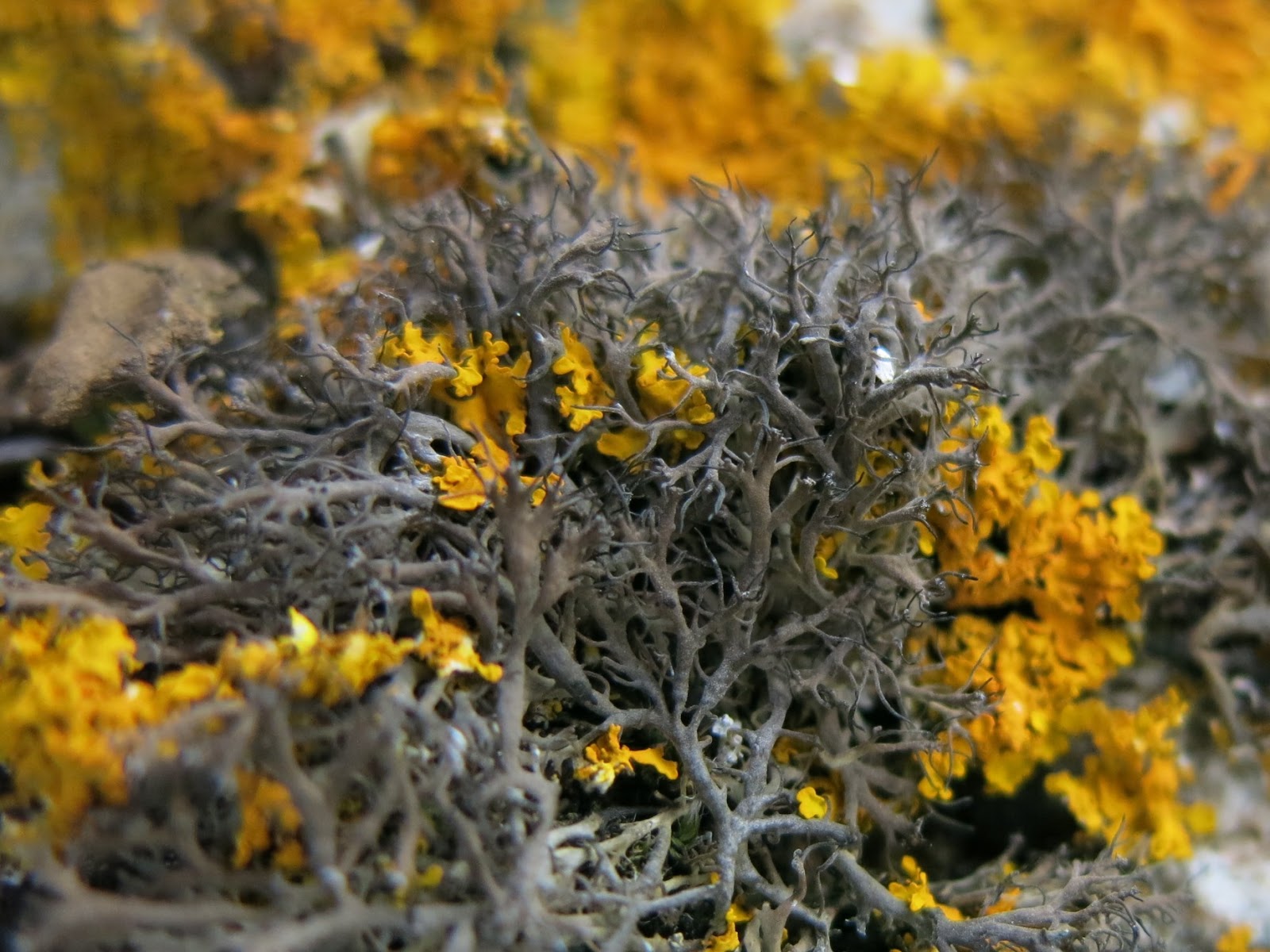
Like Graham, I was rather distracted by lichens.  Ramalina fraxinea was on a rowan and an ash, and appears to be new for VC35; R. calicaris was on the same ash, and the only previous county record was from Caerleon in 1985; Physcia leptalea was on rowan, and likewise was recorded once in 1985; Usnea articulata was on a hawthorn, representing the 3rd county record; and Usnea cf. fulvoreagans on an old fingerpost appears to be new for eastern Wales.  Sphaerophorus globosus on the same rock as the Tritomaria, and Pseudevernia furfuracea on the same signpost as the Usnea also have very few Monmouthshire records.  In truth, though, Monmouthshire is extremely under-recorded for lichens!


Friday, 15 February 2019

More Treasure in the Bracken and some Blorenge Delights


I haven’t posted for a while as I have hardly been out of the home or the office, but this week I managed to get out to the Blorenge near Abergavenny, where I found myself in an area of bracken-infested Vaccinium heath with frequent scattered boulders.  Remembering my visit to Craig y Cilau about this time last year when I found Tritomaria exsecta in similar bracken-infested and rocky habitat, I jokingly set myself the challenge of finding some T. exsecta on the Blorenge.  Amazingly, the first small rock I looked at (centre of pic) had a nice patch of Tritomaria and there were patches on other rocks nearby.  


Afterwards I checked the spores and they turned out to be nice and smooth – Sam comfirmed that it is the first record of T. exsecta for Monmouthshire since 1956.   It would be worth searching out boulders in bracken in other areas just in case the habitat turns out to be 'a fairly predictable locus' for the species.


I didn’t see many other bryos of great interest on the rocks, although there were some nice patches of Barbilophozia attenuata here and there. 


Whilst at the site I thought I would pay my respect to the large population of Andreaea rothii subsp. falcata on gritstone pavement next to the Foxhunter carpark, which I first saw about 21 years ago.  In places a small amount of water seeps from surrounding vegetation and across the rocks and in damp runnels there were a few patches of Bryum alpinum. 


  Sam informs me that this species still qualifies as a county rarity with only 5 records and that it was recorded at this very spot in 2017.  Whilst trying (and failing) to take a reasonable photo of the Bryum (I think my camera is finally starting to wear out after 17 or 18 years of use!) I noticed a dark patch of lichen out of the corner of my eye and sure enough when I took a closer look it turned out to be Umbilicaria deusta.   


The Blorenge has had some serious moorland fires in the past – the worst I recall was about 20 years ago, when the majority of the hill was burned, with pockets of peat smoking and reigniting for weeks afterwards.   About 10 years ago, just as the heathland vegetation had recovered, there was another extensive fire.  I recall visiting the area just south of the transmitter a year afterwards and was quite impressed by how large areas of bare peat had been quickly colonised by Marchantia ruderalis and also Polytrichum longisetum (pic is from back then and I expect that is longisetum in the centre).  

Today the vegetation has again recovered well, with extensive areas of heather and patches of Vaccinium vitis-idea here and there.  A close look, shows that there are still frequent bryophyte-dominated patches between the clumps of heather, but now instead of Marchantia, these are mainly dominated by Campylopus introflexus, with little bare peat.     From where I was standing I could see about 100m away some more patches of damp looking vegetation-free gritstone pavement, so I thought I would take a look to see if there was more U. deusta.   I didn’t find any of this lichen but there was a lot of Lasallia pustulata (an associate of U .deusta at most of the sites I have seen it).

There were also frequent patches of Stereocaulon – which on closer inspection turned out to be mainly S. dactylophyllum, which I haven’t seen for years.  


Also on the damp rocks was abundant Rhizocarpon lecanorinum – it also occurs more rarely on scattered boulders on the Blorenge, but perhaps these damper rocks is its preferred habitat as I have seen it in some abundance in similar habitat at Ogof Fynnon Ddu in the upper Swansea valley, also growing alongside Lasallia.   

Some blocks screes on the Blorenge support very nice bryophyte communities and some of the more exposed screes and scattered blocks that have escaped burning also have some very nice lichen communities.   Umbilicaria torrefacta is one of the more interesting lichens present – I have mainly seen it on the hill north of the transmitter, which has been less affected by fires, but it also occurs in small quantity on a handful of boulders immediately south of the transmitter and during my visit I spotted a few small patches on a couple of rocks resting on top of the gritstone pavement where the Stereocaulon was frequent. 
 Many of the scattered rocks through the heathy areas are, 10 to 20 years on, still bleached by fire damage - there is some re-colonisation, but it is slow and I doubt if I will live long enough to see species like U. torrefacta re-colonising.  The pic shows small colonies of what look like Rhizocarpon geographicum and probably represents getting on for 10 years of growth.


On returning to the car park I took a quick look at a colony of Lycopodium clavatum that Sam and I bumped in to about 20 years ago – it occupies a south-facing bank on an old spoil heap and must have really suffered during last years hot weather, so it was good to see the colony had survived and is looking relatively healthy.   


Wednesday, 28 March 2018

The Gloucestershire Bryophyte group at Llangattock

The Glos bryology group arranged an out-of-county day at the eastern end of Llangattock this year, to give us a bit of a change from the usual neutral / calcareous woodlands and grasslands of our own county. 7 of us turned up at the quarry car park on a chilly Sunday morning in March, to explore the conical spoil heaps, fallen boulders and quarry walls of the area. We didn’t get very far (as usual!), but still managed to record 97 species for the square SO2015.

Highlights of the day were Racomitrium canescens on the grassland at SO20241554, and Bryum elegans on a fallen boulder at the base of the quarry (SO20491535). Both are new species for VC 42.

Racomitrium canescens

Bryum elegans in situ


Bryum elegans: Note reflexed hair-points and border of long narrow cells

We spotted some lovely patches of Sanionia uncinata sheltered within the walls of an old building and scattered throughout the grass on the spoil heaps above.


The Climacium dendroides was looking particularly photogenic and I just couldn’t resist...


We saw Philonotis calcarea, new to many of us, and Sharon Pilkington unintentionally collected Philonotis arnelli in amongst another specimen. Sharon also spotted Distichium inclinatum on the outside wall of the derelict building – there were old capsules which were clearly inclined, and new ones coming which I will go back and photograph if I get a chance.

Further to the west, David Hawkins found Calliergon cordifolium in shallow pools on the quarry bottom, but sadly the inevitable rain arrived about then, so we have no photos.

Finally, not to forget the liverworts, some beautiful Ptilidium ciliare on rocks amongst the grassland to the west of the spoil heaps:


And Tritomaria quinquedentata on the spoil heaps amongst the grass and other bryophytes:


All in all, we had a fantastic day and are planning a return trip soon for those who couldn’t make the first visit.

Saturday, 6 May 2017

A weekend on Lundy - mosses and liverworts

Clare and I spent the bank holiday weekend on the magical Lundy Island, sailing from Bideford after dropping Bea and Johnny with their grandparents in Sussex.  South Wales was visible from Lundy (when it wasn't raining), so perhaps it isn't stretching the Blog title too much to mention some of the bryophytes I bumped into during our visit.  Clare enjoys walking for walking's sake, whereas I walk to get to recording sites, but we had a good compromise where Clare strode between headlands and waited with a book whilst I made a few stops in between; we did plenty of walking together too.


On our first day included a walk up the west coast of the island as far as the Halfway Wall.  The path down to the Battery produced Anthoceros punctatus (photo) and Tritomaria exsectiformis (photo), whilst rocky heathland a little further north held Kurzia sylvatica.  A flushed area (photo) with Bryum alpinum also supported Fossombronia sp with violet rhizoids, which I suspect is F. maritima; I'm growing some on in a tube in the hope of sporophytes.  Pogonatum nanum (photo) was fruiting beautifully on a bank nearby.


Our second day was marred by heavy rain in the morning, but we ventured out a few times along the east side of the island.  Bryological highlight was Frullania teneriffae (new for VC4) alongside Scapania gracilis in the VC Quarry (photo).  Exploration of the wooded Millcombe valley produced Epipterygium tozeri, Pohlia lutescens and Plagiochila asplenioides, whilst Schistidium rivulare was a surprise on rocks in the Quarter Wall Pond.


Our third and final day involved a stomp along 'The High Street' to the north end of the island (4 km away from The Village) followed by a walk back along the east side.  Lepidozia cupressina (photo) and Dicranum scottianum (photo) grew together on a tor just south of Gannets Coombe - like Dartmoor in miniature - and there were Cephalozia connivens and C. lunulifolia nearby.  Salt-sprayed turf near the northern lighthouse held Hennediella heimii, and a Bryum nearby looked interesting but was unfortunately non-fertile.  Finally, an exploration of Landing Bay while we waited for the boat back to the mainland produced Schistidium maritimum and Weissia perssonii at last: most of the island is too steep to allow descent to the maritime areas favoured by these species.


I don't actually know how many of the 100+ species that I recorded (with 8-fig GPS readings) were new for the island.  The BBS dataset seems extremely incomplete, especially for liverworts, with some broad-date 20th century records and a list made by Mark Pool in 1997; I added nearly 30 species to the hectad tally according to the BBS data.  However, Jean Paton's data from her visit in 1975 does not appear in the BBS dataset and several of my 'additions' were already recorded by her (unsurprisingly!), and Jean spotted several liverwort during her "few hours" on the island that I missed.  The Lundy Field Society reports may include other liverworts, but the issues that I looked at didn't have anything.  Mosses seem to be even more under-recorded, and the only reference I can find is a list from 1959 with IDs by Michael Proctor, and it is that list which forms the basis of the BBS data.  I will, of course, make sure that my records go to the BBS and the Lundy Field Society.

As well as the bryophytes, we saw Lundy's famous Lundy Cabbage (none of the plants by the paths were in flower unfortunately), Balm-leaved Figwort, Primrose Peerless and Ophioglossum azoricum.  Star lichens were Teloschistes flavicans and Anaptychia ciliaris subsp mamillata.  Bird highlights were the Lundy rarities Yellowhammer and Stock Dove, which I found during our wanderings, and there were various Warblers around, Black Redstart, Pied Flycatcher, Whimbrel etc.  Lundy really is a fabulous place for a wildlife-rich holiday!